Ted Peters, God—The World’s Future
God–The World’s Future is Ted Peters’ magnum opus, his most complete work.
https://tedstimelytake.com/books/god-worlds-future-systematic-theology-postmodern-era/
These three installments appear originally in Substack
https://tedp.substack.com/p/religious-pluralism-vs-comparative?r=i9tc8
Religious Pluralism vs Comparative Theology, Part 1
The Incoherence of John Hick
This fall semester, I’m teaching a graduate-level course on theological methodology. One topic the seminar explores in depth is Comparative Theology. Let’s call it CT for short. Where does CT fit with sister fields such as Religious Pluralism? Systematic Theology? Religious Studies? Public Theology?
Fortunately, here at the Graduate Theological Union (GTU) in Berkeley, we work within a multi-religious context. In addition to Christian colleagues from the Roman Catholic, Orthodox, and Protestant traditions, I meet regularly with colleagues who represent Judaism, Islam, Hinduism, Baha’i, Buddhism, and occasionally New Religious Movements. Should you wish to pursue comparative theology, Berkeley has the sandbox to play in.
The scholarship of Rita D. Sherma is well worth taking a moment to recognize and appreciate. Professor Sherma is the founding Director and Associate Professor at the GTU’s Center for Dharma Studies as well as editor of the Journal of Dharma Studies. I want to take a moment to reflect on what she says in an innovative book chapter, “Critical Interreligious Interdisciplinary Theological Reflection” (Sherma, 2022). I’d like to ask: what is Rita’s distinctive contribution to Comparative Theology?
Here’s the answer, just in case you want to stop reading here. She adds two items to the CT agenda: (1) immersion in a religious tradition other than your own, plus (2) constructive theological reflection on this engagement on behalf of your own confessional commitment.
Let me take on this topic in two posts. In this, the first one, let’s remind ourselves of the belief system generated by the previous generation of religious pluralists, principally John Hick. In the next post, we will take up Rita Sherma’s rendering of CT and demonstrate its independence from Religious Pluralism.
Background: The Doctrine of Religious Pluralism
“The pluralist position is that there are many roads leading to the same goal. Buddhism, Islam, Judaism, and Christianity are merely different ways to salvation,” claims theologian Paul E. Capetz (Capetz, 2005, p. 63). How did we arrive here? What’s the background?
That we live in a global culture with a plurality of religious worldviews is an observable fact. We experience a plurality of reality-defining worldviews both between religious traditions and within our own religious traditions. Sects and denominations, along with rebellions against sects and denominations, are common. Let’s call this description religious plurality.
Then, there is religious pluralism. Might we call it RP? Because of the “…ism,” we find ourselves now in the domain of ideology. Mushrooming in the 1980s and persisting down to the present day, RP believers seek to override more parochial and narrow-minded devotees who think their own perspective on reality is definitive. RP seers oppose religious exclusivists (also called restrictivists or particularists) who allegedly contaminate global culture with parochialism, dogmatism, chauvinism, and factionalism.
“Religious pluralism is the view that there is no one-and-only true and salvific faith,” writes philosopher of religion John Hick. “Pluralism regards all the great world faiths as equally authentic and salvific” (Hick, 2010, p. 153). Hick, according to Dennis Okholm and Timothy Phillips, “towers over all other pluralists in influence and renown” (Okholm & Phillips, 1996, p. 13).
Hick first negates the path taken by particular belief systems, such as we find in Christianity, Islam, or Buddhism. He objects that such reality-defining traditions are exclusivist—that is, they deny the saving efficacy of their competitors. In contrast, Hick assures us that every religious tradition has saving efficacy.
Now, Hick does not stop there. He goes on to provide his own version of ultimate reality.
“The pluralistic hypothesis [attempts] to account for the existence of the different religio-cultural totalities…We have to postulate an ultimate transcendent reality, the source and ground of everything, that is in itself beyond the scope of human conceptuality but is variously conceived, therefore variously experienced, and therefore variously responded to in life, from within these different religious totalities” (Hick, A Pluralist View, 1996, pp. 49-50).
This “transcendent reality,” Hick posits, is ultimate reality. It is so sublime that it outdistances the most sublime thoughts of Christians or Daoists, or Muslims.
Transformation from Self-Centeredness to Reality-Centeredness
One characteristic of each religious tradition, I have observed, is that it constructs a worldview. A comprehensive worldview. In fact, each religious worldview is reality-defining. Religious people interpret their experiences within the reality-defining symbol system of their tradition. What happens when the scholar attends to the fact of plurality, to the fact that differing yet competing reality-defining worldviews sit side-by-side in our global community? Religious Pluralism comes to the rescue.
RP holds that “the great world faiths embody different perceptions and conceptions of, and correspondingly different responses to, the Real from within the major variant ways of being human; and that within each of them the transformation of human existence from self-centeredness to Reality-centeredness is taking place” (Hick, An Interpretation of Religion, 2004, p. 240).
Authentic though perspectival knowledge of the Real, along with salvation, is offered by every particularist or exclusivist religion. “Normative religious pluralism maintains that the major world religions provide independent salvific access to divine reality” (Okholm & Phillips, 1996, 17). The plurality of religions is dissolved into the blurry unity of the Real that incorporates all of our historically specific reality-defining symbol systems.
Hick’s term, the Real, designates what others mean when speaking of God, the Sacred, the transcendent, the ultimate reality, and such. When persons claim experiences of revelation, Hick refuses to call them “illusory.” Rather, “they are empirically, that is experientially, real as authentic manifestations of the real” (Hick, An Interpretation of Religion, 2004, p. 242). On this point Hick bestows dignity on each and every religious tradition. Thank you, Dr. Hick.
So, on the one hand, Hick compliments particularist religious traditions for experiencing reality authentically. Yet, on the other hand, Hick denies to particular religious traditions awareness that the Real is shared with other particularist traditions. Here is my formulation of Hick’s position: each particularist religious person is stuck in a particularist set of symbols that perspectively mediate the sublime reality that transcends those symbols. Only a religious pluralist such as Hick knows this universal truth, a truth that escapes the perspectival limitations of those within any one particular religious tradition. Hick’s position is surpa-confessional or supra-religious, unencumbered with the perspectival limitations of those who live within a particularist tradition.
Curiously, Hick is himself making a faith statement that attempts to define ultimate reality. He says there is one ultimately real divine reality known as the Real. By making this claim, he accidentally places himself in the category of one more religious point of view among others. Hick’s dogma — that the Real is ultimate reality — becomes one more contextually specific or perspectival reality-defining speculation comparable to the Hindu concept of Brahman or the mystic’s experience of cosmic unity.
An Assumption or a Conclusion?
One more observation. For Hick and his RP colleagues, knowledge of the Real and the salvific efficacy of every religious tradition is an assumption. It is not a conclusion.
Bizarrely, to assert that salvation is found in every religion is a statement of faith. It is not based upon Hick’s own pilgrimage toward salvation within Buddhism and Confucianism along with all the others. It is not based on his immersion in any exotic reality-defining religion. Without actually experiencing what Buddhists or Confucianists experience, the religious pluralist claims a priori that each path leads to salvation and union with the Real. This is an assumption; not a conclusion.
This is why I believe RP should be considered one more particularist confession of faith. To my judgment, this renders the universalist hegemony of Religious Pluralism incoherent. Elsewhere, I call the RP position Supra-Confessional Universalism (Peters, 2015, p. Chapter 12).
Diana Eck’s Alternative Version of Pluralism
Harvard’s Diana Eck lets the term, pluralism, interpret genuine plurality as plurality. Whereas Hick’s RP eliminates pluralism by uniting it within a common ground, the Real, Eck resists such a hegemonic amalgamation.
Eck employs the metaphor of a “world house,” within which live differing religious perspectives as a single family. Together, they engage one another, seeking to understand one another in their differences. The Eck method differs from the Hick method of subordinating the differing perspectives to a transcendent Real. “Religious pluralism is not primarily about common ground,” she writes. “Pluralism takes the reality of difference as its starting point. The challenge of pluralism is…to discover ways of living, connecting, relating, arguing, and disagreeing in a society of differences” (Eck, 2007, p. 745).
Transitional Conclusion
I find the claims of Religious Pluralism incoherent. By defining reality with a concept such as the Real that competes with other religious symbol systems, RP becomes one more denomination among others. RP should not be issued a patent on ultimate reality.
Of significance, I think, is the RP claim that differing religious traditions are all in tune with the same Real and all are equally salfivic. This claim is not a judgment resting on empirical evidence.
In our next post we will turn to Dharma theologian Rita D. Sherma. Sherma requires immersion in a religious tradition before rendering a judgment about salvific efficacy or anything else.
References
Capetz, P. E. (2005). God and Religious Diversity: Toward a Theocentric Pluralism. In P. L. Serene Jones, Constructive Theology: A Contemporary Approach to Classical Themes (pp. 60-66). Minneapolis MN: Fortress.
Eck, D. (2007). Prospects for Pluralism: Voice and Vision in the Study of Religion. Journal of the American Academy of Religion 75:4, 740-750.
Hick, J. (1996). A Pluralist View. In T. P. Dennis Okholm, Four Views on Salvation in a Pluralistic World (pp. 29-60). Grand Rapids MI: Zondervan.
Hick, J. (2004). An Interpretation of Religion. London: Yale University Press.
Hick, J. (2010). The New Frontier of Religion and Science. New York: Macmillan Palgrave.
Okholm, D. L., & Phillips, T. R. (1996). Introduction. In T. R. Dennis L Okholm, Four Views of Salvation (pp. 13-26). Grand Rapids MI: Zondervan.
Peters, T. (2015). God–The World’s Future: Systematic Theology for a New Era (3rd ed.). Minneapolis MN: Fortress Press.
Sherma, R. D. (2022). Critical Interrelgious Interdisciplinary Theological Reflection. In e. Lucinda Mosher, The Georgetown companion to interreligious studies (pp. 480-490). Washington DC: Georgetown University Press.

Religious Pluralism vs Comparative Theology, Part 2 How Rita Sherma advances the discipline After reviewing our background in the school of thought we know as Religious Pluralism or RP, we turn here in this second of three posts to the stride forward taken by Rita D. Sherma. This step leads us from incoherent RP to the discipline of Comparative Theology (CT). Whereas RP is constituted by a mere faith statement that all religions are in touch with transcendent reality and have salvific efficacy, CT is constituted by rational reflection on one’s own confessional stance. Both the home religion and the neighbor’s religion provide what we might call the data of theological reflection. To extend our conversation I would like to concentrate on Rita Sherma’s illuminating book chapter, “Critical Interreligious Interdisciplinary Theological Reflection” (Sherma, 2022). In the subsequent third post in this series, I would also like to introduce the Theodaoianism of Heup Young Kim at Kangnam University in South Korea. We will ask if Professor Kim unknowingly follows Professor Sherma’s CIITR method when immersing himself in Daoism in order to enrich Christian theology. Professor Rita D Sherma Critical Interreligious Interdisciplinary Theological Reflection (CIITR) Comparative Theology is genuine theology. It does not belong in Religious Studies. The comparative theologian reflects rationally on sacred texts, symbolic meaning, religious experience, confessional statements, and personal faith. Charissa Jaeger-Sanders, a doctoral student of Rita Sherma and Teaching Assistant in our fall semester seminar, proudly appeals to the four sources of the Wesleyan Quadrilateral: scripture, tradition, reason, and experience. In short, the comparative theologian reflects on data before touting conclusions about ultimate reality. The Wesleyan Quadrilateral was originally intended to identify the sources upon which the Christian theologian would reflect. That is, Wesleyans employed the quadrilateral for distinctively Christian theology. Might it work as well for the comparative theologian working in two or more traditions? Yes. “Traditionally,” observes Rita Sherma, “comparative theology is the work of bringing theologies of two different traditions together for examination of their convergences and divergences” (R. D. Sherma 2022, 480). But Sherma along with Jaeger-Sanders wants more than mere comparison. These two scholars want constructive theological action. To take that theological step forward, Sherma introduces Critical Interreligious Interdisciplinary Theological Reflection (CIITR). CIITR “reflects the importance of partnership and collaboration in the field of comparative theology toward conceptualizing and contributing together—at the highest level of thought and action—to viable pluralistic societies” (R. D. Sherma 2022, 480). A Problem: Abstract Rational Theology vs Immersive Experience CT must resolve a problem arising from the distinction between broad religious experience and narrow rational reflection on that experience. This distinction risks falling into a split between logos and praxis, theology and practice. Kangnam University systematic theologian Heup Young Kim criticizes existing CT because CT presupposes an unnecessary dichotomy between rational reflection and liberation praxis. Comparative theologians need to do more than merely read books. “Comparative theology primarily refers to a theological enterprise of Western scholars who attempt to incorporate new insights acquired from the experiences of new Asian vistas….Most comparative theologians in the West learn the other traditions through literature studies, without necessary first hand experiences” (Kim, A Tao of Interreligious Dialogue in an Age of Globalization: An East Asian Perspective 2005, 491). Rita Sherma meets Kim’s critique with her concept of immersive experience, buttressed by her hermeneutical assumptions regarding the fusion of horizons. Hermeneutical Insights Sherma is schooled in continental hermeneutics. She borrows from Heidelberg’s Hans-Georg Gadamer the notion of fusion-of-horizons, Horizontverschmelzung. What philosopher Gadamer makes us aware of is the role of the unsaid (das Ungesate) in everything that gets said (das Gesagte). When you and I construct a sentence and speak, the meaning of what we say is complemented by all sorts of cultural background that does not get said. This historically inherited cultural background is what Gadamer calls the ‘horizon’ of understanding. How might you or I become attuned to the horizon of understanding in a different religious tradition? Sherma’s answer: through immersion. Simply studying the writings of religious scholars is not enough. We must place ourselves in the midst of the daily life of those within the tradition we wish to come to understand. “Depth of understanding in comparative theology requires immersive experience. Yet immersion does not imply an abdication of commitment to one’s own religious heritage” (R. D. Sherma, Critical Interrelgious Interdisciplinary Theological Reflection 2022, 483). As you can see, the CT scholar seeks immersive experience, but this does not require abdicating confessional commitment. What Sherma hopes from the immersive experience is some degree of horizon fusion of the two traditions. Here is an important takeaway. The theological method proposed by Rita Sherma is reversible. On the one hand, a Hindu theologian could engage in Christian immersion to enrich Dharma theology. On the other hand, a Christian theologian could engage in Hindu immersion to enrich Christian theology. Decoloniality Theory as Liberation Praxis Sherma is as concerned about praxis as she is logos. Sherma’s approach to praxis draws upon decoloniality theory. She believes decoloniality theory leads CT to the recognition of the danger of universalizing Western frames of reference uncritically and globally. The element of decoloniality locates precolonial indigenous epistemologies and revives “long-submerged ways of being and becoming to bring them into conversation with the reality of a globally interconnected civilization” (R. D. Sherma, Critical Interreligious Interdisciplinary Theological Reflection 2022, 485-486). Decoloniality opens “the possibility that other-than-Western religious, ecological, aesthetic, and economic knowledge systems have something valuable to teach us. Through such acknowledgment, epistemic justice becomes feasible. This opens up the possibility of reciprocal illumination” (R. D. Sherma, Critical Interrelgious Interdisciplinary Theological Reflection 2022, 487). At this point, I believe Sherma’s CT contributes to liberation praxis within public theology. Public theology, though conceived in the church and critically refined in the academy, is offered to the world outside the church for the sake of the common good. In his book, Postcolonial Public Theology, Paul S. Chung relies on “postcolonial theory” to challenge “the cultural and economic legacy and aftermath of colonialism which continues in previously colonized countries”(Chung, 2016, 194). Even though for Sherma immersion leads to rational theological construction within one’s own confessional tradition, decoloniality offers the product of theological reflection to an indigenous epistemology for its own sake. The resurfacing of a submerged epistemology serves the global common good. In this regard, CT is a form of public theology. Transitional Conclusion According to Harvard’s Francis X. Clooney, genuine comparative theology is “mutually enriching.” This is due to the deep learning component when we cross “religious borders.” The comparative theologian seeks “to learn deeply across such borders” (Clooney 2010, 5). Deep learning requires deep reflection, not simply learning the history and thought of a different tradition. “If we are trying to make sense of our situation amidst diversity and likewise keep our faith, some version of theological reflection is required” (Clooney 2010, 3). Crossing over to engagement with the other prompts a return reflection within one’s own confession. What is Rita D. Sherma’s stride forward? On pace with Clooney’s advocacy for “deep learning,” Sherma contributes three valuable items to the CT agenda: (1) immersion in a religious tradition other than your own; (2) constructive theological reflection on this engagement on behalf of your own confessional commitment; plus (3) decolonial praxis that serves submerged indigenous epistemologies. With immersion, the CT scholar will find enrichment when pursuing constructive reflection within his or her or their home confession. In brief, Sherma integrates both rational reflection (logos) and liberation (praxis). Perhaps even a fusion of horizons! Along with Charissa Jaeger-Sanders, our learnéd and delightful teaching assistant, I hope our fall semester seminar will fuse a number of student and faculty horizons. 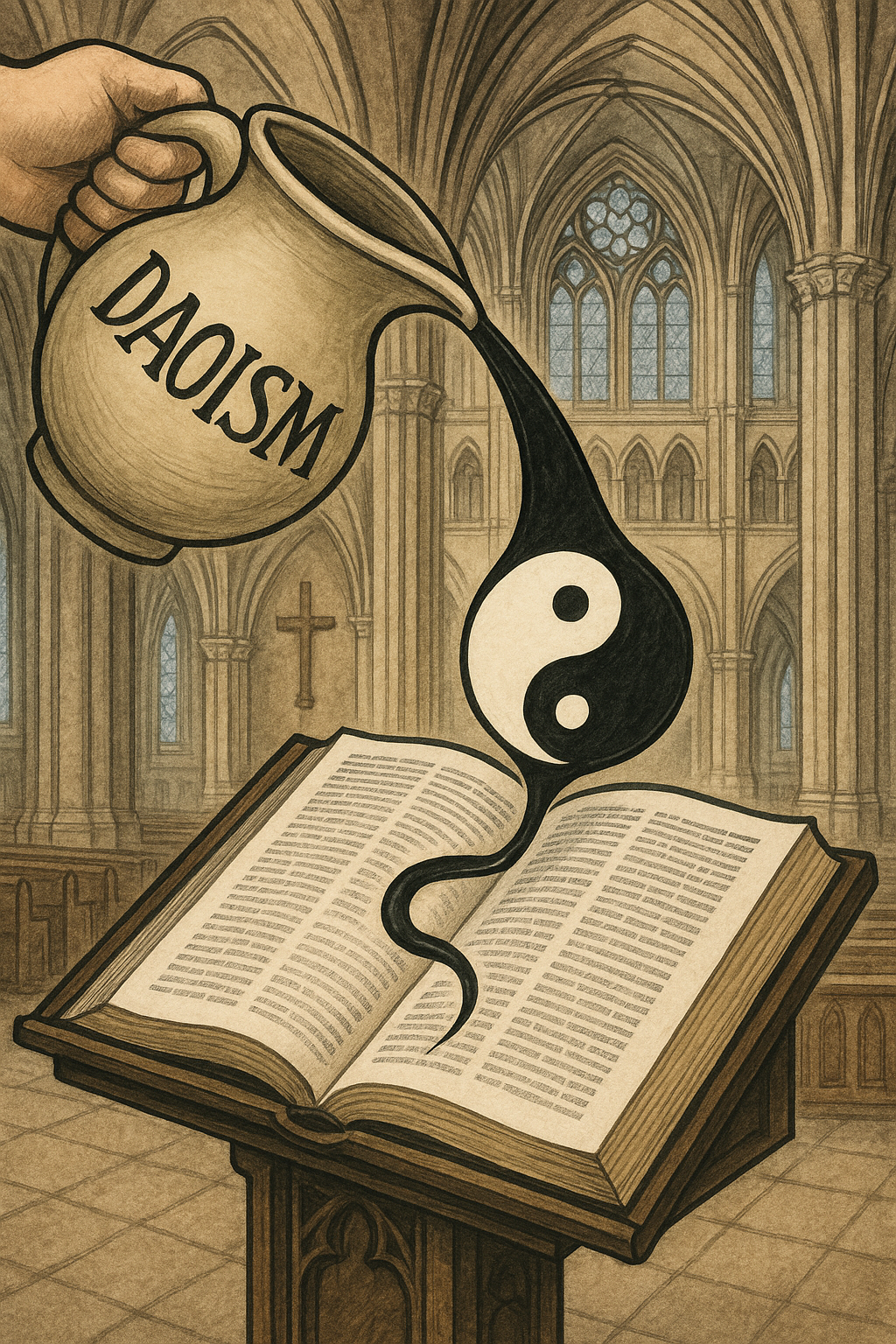 Religious Pluralism vs Comparative Theology, Part 3: Heup Young Kim’s Theology of the Dao As we bid adieux to the buzzing of interreligious dialogue and take up the tasks of Comparative Theology (CT), theologians might be tempted to harvest the nectar of other religious hives and pour it into the doctrinal vessels of their own tradition. As we saw in the first post on John Hick and the second post on Rita Sherma, this is just what the comparative theologian is likely to do. Professor Heup Young Kim at Kangnam University in South Korea is pouring the spirits of Daoism into partially empty Christian goblets. Why? For two reasons. First, to indigenize Christian faith on Korean soil. Second, to repair something broken within Western Christian theology, namely the dualism between logos and praxis, between mind and heart, between the rational and the practical. Liberating Korean Christianity from Western Hegemony The first problem Professor Kim wants to address is the hegemony of Western ways of thinking in an East Asian context. Kim faults the missionaries for repressing traditional ways of thought such as Confucianism and Daoism. “Remembering the tragic mission history of Western religious imperialism, discourses on multiple-religious belonging need to begin with metanoia in order to be free from Western propensities to subdue or colonize things in their mission fields…an original sin of Western imperial Christianity” (Kim H. Y., A Theology of Dao, 2017, pp. 183-184). The replacement of traditional epistemologies with European rationality is the “original sin of Western imperial Christianity.” Kim wants to provoke a metanoia, a liberation. In fact, Kim wants to import liberation theology to the Korean peninsula “to be set free from Western propensities.” Gluing Together Logos and Praxis with Daoist Glue The second problem Professor Kim wants to address is an unfortunate dualism within Western Christian thought. It is the dualism between logos and praxis, between mind and heart, between rational theology and daily spiritual or ethical living. This split between logos and praxis does not exist in East Asian thinking, avers Kim. “Asian religious visions are characteristically more holistic, inclusive, and ecological, namely, anthropocosmic (humanity and the cosmos being interrelated) or even theanthropocosmic (God, humanity, and cosmos being interrelated)” (Kim H. Y., A Theology of Dao, 2017, p. 16). . Therefore, contends Kim, by pouring holistic Daoist monism into the hiatus between logos and praxis we can heal the split in the Christian mind. Dao or 道 refers to a way, path, channel, or doctrine that leads us to the unity from which we have fallen into duality. The original unity can be regained through nonaction, through realizing the ying-yang dialectic in the practice of wu wei. The Daoist’s action that is nonaction seeks to avoid self-assertion, disruption, violence. “I propose Tao (the way of life), instead of logos and praxis, as an alternative root metaphor for theological and interreligious discourse in an age of globalization. In contrast to theo-logos (classical theologies) and theo-praxis (liberation theologies, I call this paradigm of theology theo-tao” (Kim H. Y., A Tao of Interreligious Dialogue in an Age of Globalization: An East Asian Perspective, 2007, p. 489). Another contemporary Korean theologian, Andrew Sung Park at United Theological Seminary in Dayton, Ohio, would approve of this conflation of Dao with the biblical God. “The nameless Tao corresponds to YHWH in the Hebrew Bible,” observes systematic theologian Andrew Sung Park (Park, 2001, p. 391). It’s a natural fit. Extending the logos principle of John 1, Kim can also identify the Dao with the second and third persons of the Holy Trinity. Breviloquently, here is Kim’s Christology. “Christodao can be further thematized. Jesus is the Dao, the supreme paradox of the Great Ultimate and the Non-Ultimate (T’aegŭk and Mugŭk), the Primordial Breathing, the Being-in-Non-Being, and the complete emptiness (kenosis or sunyata) that is none other than the complete form. The cross refers to the rush to the cosmic path, and resurrection signifies the Christological transformation of the theanthropocosmic trajectory. The crucifixon of Jesus was a cosmogonic crucifixion, which changed the cosmic path” (Kim H. Y., A Theology of Dao, 2017, p. 49) Ponder for a moment the concept of Christodao. With Christodao Kim cosmicizes Jesus in a way akin to the logos in John 1. Does Dao add something missing in logos? Yes, answers Kim. It adds an intrinsic incorporation of praxis. Public theologian Paul S. Chung might be ready to welcome Kim into his CT club. “If comparative theology is located in dialogue with the other religion, interreligious learning is appropriate in shaping a notion of Christian mission anew in this comparative context” (Chung P. S., 2017, p. 1) In brief, Kim has compared and contrasted traditional Daoism with Western Christianity. Then, to enrich Christian doctrine and practice, he has poured the notion of the Dao into Christian thinking to produce Theodaoianism and even Christodaoism. In principle, Kim seems to fulfill Rita Sherma’s double requirement for Comparative Theology: immersion and reflection (Sherma, 2022) Is the Dao the Right Fit? Heup Young Kim has received criticism from another theologian sharing the same moniker, James Jinhong Kim. According to J.J. Kim, theodaoianism is not capable of Korean indigenization because Daoism had already become effete before Christian missionaries arrived in the nineteenth century. “One cannot propose a “theo-Dao” as a solution or an alternative to Western theology (maybe “theo-logos” or “theo-logy”) when this “theo-Dao” has had no history of success or indeed even of application as contemporary Daoism, much less as part of Asian Christianity. Daoist philosophy and spirituality lost its vitality (i.e., its ability to identify and directly address fundamental issues of society) in Asia before the arrival of challenges from abroad, and it has yet to demonstrate the recovery of that vitality in Asia. That is to say, Daoism in Asia has yet to develop the wherewithal within itself to engage with Western or Christian teachings in such meaningful ways as to have become a necessary sustaining value in today’s largely Westernized Asia” (Kim J. J., 2020, pp. 54-55) If Daoism was already spiritually dead before the Korean adoption of the Christian faith, how could it function to liberate Korean Christians today? Praxis as Nonaction and as Liberation Certainly, Heup Young Kim will find Korean compatriots among public theologians, especially Paul S. Chung. “Postcolonial theology attempts to transcend the afermath of colonialism by moving beyhond the colonial or neocolonial forms of global domination…[beyond] the panopticon of globalization [that] enforces a homogenization of narratives, forgetting and trampling over the countless indigenous and subalternized stories” (Chung P. , 2016, p. 187) Despite sharing a decolonial ethic, there is a difference between Chung and Kim. Chung relies solely on Christian resources, such as the centrality of Jesus Christ in Karl Barth’s Church Dogmatics (Chung P. S., Karl Barth: Gods Word in Action, 2nd ed., 2015). Kim feels a need to supplement distinctly Christian resources with something essential from Daoism, namely, the concept of wu wei spirituality. I find it curious that Heup Young Kim thinks Daoist spirituality or ethics could undergird Christian liberation theology. The liberation agenda in culture and politics is a distinctive European Enlightenment idea, even when it inspires the victims of colonialism to throw off colonialism. Liberation ethics requires action, especially self-generated action that transforms the repressive structures of a social situation. Daoist wu wei, in sharp contrast to liberation ethics, cultivates a spirituality of inaction. For the Daoist, our lost cosmic unity can be regained through nonaction, through realizing the ying-yang dialectic. The Daoist’s action that is nonaction seeks to avoid self-assertion, disruption, violence. Wu wei, it appears to me, would lack the liberative architecture needed to build a movement aiming at a revolution against oppressive structures in culture, economics, or politics. Now, I just might be mistaken. Let’s look at practice. Chinese feminist scholar Wai Ching Angela Wong finds various religions – including both Daoism and Christianity – liberative for oppressed women. Wong interviewed women in Hong Kong. “Whether Christianity, Daoism, Islam, or Buddhism…religion offered a home away from home that enabled women to step out of family and cross over to a physical and symbolic space to exercise their will. In the liminal and transgressive space away from the family, religiously dedicated women stride into alternative avenues for action and execute changes to their life course” (Wong, 2023, p. 126). I note how both Daoism and Christianity are listed as liberative. Nevertheless, I’m not yet persuaded that Daoist non-action is the best fit for Christian liberation theology. It seems to me that Heup Young Kim should pour into his Western Christianity a different East Asian benefaction. Conclusion Heup Young Kim’s lengthy and distinguished career as an intellectual leader will be celebrated in 2027 with a Festschri in his honor. It is tentatively titled, New Theodaoian Horizons: Essays in Honor of Heup Young Kim. The volume will be edited by Archie Lee, Paul Hedges, Wai Ching Angela Wong, and Chung-Hyun Baik. We can begin now to look forward to its publication. References Chung, P. (2016). Postcolonial Public Theology: Faith, Scientific Rationality, and Prophetic Dialogue. Eugene OR: Cascade Books. Chung, P. S. (2015). Karl Barth: Gods Word in Action, 2nd ed. Eugene OR: Wipf and Stock. Chung, P. S. (2017). Comparing Multiple Theologies Among Modernity. New York: Palgrave Macmillan. Kim, H. Y. (2007). A Tao of Interreligious Dialogue in an Age of Globalization: An East Asian Perspective. Political Theology 6:4, 487-499. Kim, H. Y. (2017). A Theology of Dao. Maryknoll NY: Orbis. Kim, J. J. (2020). A Theology of Dao. International Bulletin of Mission Research 44:1, 52-57. DOI: 10.1177/2396939319847427 i. Park, A. S. (2001). A Theology of the Way. Interpretation 55:4, 389-399. Sherma, R. D. (2022). Critical Interrelgious Interdisciplinary Theological Reflection. In e. Lucinda Mosher, The Georgetown companion to interreligious studies (pp. 480-490). Washington DC: Georgetown University Press. Wong, W. C. (2023). Beyond the Boundary of Home: Religion, Space, and Women in Hong Kong. Journal of Feminist Studies in Religion 39:1, 111-127. Doi.org/10.2979/jfs.2023.a893195. |
Author Bio. Ted Peters (Ph.D., University of Chicago) is a public theologian directing traffic at the intersection of science, religion, and ethics. Peters is an emeritus professor at the Graduate Theological Union, where he co-edits the journal, Theology and Science, on behalf of the Center for Theology and the Natural Sciences, in Berkeley, California, USA. He recently co-edited Astrobiology: Science, Ethics, and Public Policy (Scrivener 2021) as well as Astrotheology: Science and Theology Meet Extraterrestrial Intelligence (Cascade 2018). Peters has published an edited volume, The Promise and Peril of AI and IA: New Technology Meets Religion, Theology, and Ethics (ATF 2025). Along with Arvin Gouw and Brian Patrick Green, he co-edited the recent book, Religious Transhumanism and Its Critics (Roman and Littlefield/Lexington, 2022) and with Arvin Gouw co-edited The CRISPR Revolution in Science, Religion, and Ethics (Bloomsbury 2025). His fictional spy thriller, Cyrus Twelve, follows the twists and turns of a transhumanist plot. See his blogsites [https://www.patheos.com/blogs/publictheology/] and [https://tedp.substack.com/] along with his website [TedsTimelyTake.com].