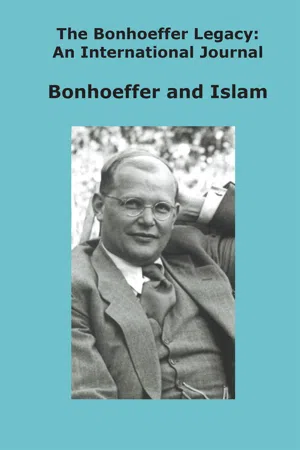
Dietrich Bonhoeffer and Comparative Religion:
Genealogical Analyses in Christianity, Judaism, and Islam
Citation Policy
Paul S, Chung, “Dietrich Bonhoeffer and Comparative Religion: Genealogical Analyses in Christianity, Judaism, and Islam,” Comparative Religion & Multicultural Literature, vol. 1, No.1, Spring (2025) at https://youngsung.devmisc.com/comparative-religion/genealogical-analyses-in-christianity-judaism-and-islam/
Introduction
Bonhoeffer’s writings demonstrate an awareness of how Islam integrates religion with everyday life in a way that is also reflected in the Hebrew Bible. He would not have been hostile toward Islam. In fact, Bonhoeffer is gaining recognition within Islamic studies for the integrity of his life and actions.
Bonhoeffer’s theological thinking was deeply centered on the Jewish-Christian relationship during the era of National Socialism, as well as on the challenges posed by a secular modern world. However, he did not engage directly with Islam or its social and religious dynamics.
Bonhoeffer’s concept of religionless Christianity can be understood as a critique of Christian religious practices that function as ideological interpellations—especially German Christian nationalism—which failed to uphold the church’s responsibility toward persecuted Jews, the poor, and secular society. Rather than excluding non-Christian traditions, Bonhoeffer’s perspective may resonate with, or be placed in dialogue with, insights from Muslim intellectuals. Indeed, his thought can be extended into a genealogical study of religion in both Judaism and Islam (see Lovat, “Bonhoeffer’s Religionless Christianity in Conversation with Islamic Scholarship,” pp. 157–171).
I approach Islam from a lifeworld perspective, which, within a social scientific framework, serves as a response to anti-Muslim bigotry and systemic racism. This approach integrates the historical-critical study of Islam with attention to broader civilizational phenomena such as involvement, compromise, and transformation within the universal history of religion. A correlation method allows for a more nuanced understanding of how religious language and symbols are entangled with material interests, agency, and the dynamics of power in social organization and the politics of meaning. The method of correlation seeks to engage with and recognize cultural and religious exchange within the broader framework of the universal history of religion.
Axel Honneth offers critical theoretical insights into the concept of recognition in Hegel’s philosophy. He aligns Hegel’s theory of rationalization and ethical significance with Émile Durkheim’s sociology, particularly the division of labor and the principle of organic solidarity. Honneth’s interpretation of Hegel’s philosophy of recognition also contains implicit interfaith implications (Honneth, The I in We, p. 65).
However, I argue that Honneth tends to sidestep Hegel’s philosophy of religion, which provides a framework for interfaith interaction through the dual concepts of reconciliation and recognition. According to Hegel, recognition is not grounded in paternalism, but rather in the process by which formerly dominated groups come to recognize the human dignity of the previously dominant class—even after conflict or defeat. This dynamic implies a vision of restorative justice and a renewed social obligation to the common good, both of which are central to Hegel’s reflection on the meaning of “The I in We.”
Hegel was profoundly influenced by Luther’s theologia crucis, a theological orientation that also lies at the heart of Bonhoeffer’s ethics of reconciliation. This perspective enables a genealogical interpretation of world events through the lens of suffering—placing those who endure violence, marginalization, or exclusion at the center of ethical reflection and historical meaning.
Recognition, when understood in the context of reconciliation, functions as a form of restorative justice, cultivating a politics of meaning that supports the struggle for what is real. It draws on its internal strength to “impose upon the world a particular conception of how things at bottom are and how men are therefore obliged to act…by sudden irruptions from the screened off political course” (Geertz, The Interpretation of Cultures, p. 316).
In this essay, I seek to reconstruct Bonhoeffer’s theology in dialogue with Jewish thought and the Palestinian crisis, highlighting his relevance to contemporary questions of Israel and distributive justice (suum cuique). I engage with biblical narratives on the promise of land and the rights of Palestinian Christians.
Next, I adopt a method of religious construction of socio-cultural reality to explore how the history of Islam contributes to intellectual achievement, civilizational development, and an alternative path to modernity within a post-Eurocentric framework. I compare Clifford Geertz’s anthropology of religious symbols with a genealogical approach developed by Saudi-born cultural anthropologist Talal Asad, who defines religion as a system of discourses and representations embedded in power and practice.
Finally, I address Islamic contributions to modernity, public theology, and interfaith dialogue, using the significance of Jesus in Islam as a case of mutual recognition and the politics of meaning.
Dietrich Bonhoeffer in Reconstruction
To reconstruct Bonhoeffer’s theology within the framework of Abrahamic dialogue among Christianity, Israel, and Islam, it is essential to highlight his reflections on the legacy of European modernity and the Janus-faced character of the secular, mature world. His theology of the cross, grounded in Christological collectivism, functions as a biblical symbol of reconciliation that transcends confessional boundaries.
This synthesis of symbol and meaning underscores a politics of recognition, offering both a critical reassessment of Bonhoeffer’s theology of Israel and an expression of solidarity with innocent Palestinian victims. In doing so, Bonhoeffer’s theological legacy becomes a resource for fostering interfaith engagement, ethical responsibility, and restorative justice within the complex realities of the Abrahamic traditions.
According to Bonhoeffer, the modernist developments following the French Revolution and the rise of European humanism can be categorized into three interrelated crises: anti-Semitism, secular atheism, and the plight of the fourth estate—the working class suffering under conditions of poverty.
Bonhoeffer’s deepest concern, however, was the violent persecution of Jews, particularly the Kristallnacht pogrom of 1938, which he saw as emblematic of the moral failure of capitalist modernity and the ruthless underside of European humanism. At the height of Hitler’s power and popularity in 1941, Bonhoeffer boldly asserted:
“Western history is by God’s will inextricably bound up with the people of Israel, not only genetically but in an honest, unceasing encounter. The Jew keeps open the question of Christ… Driving out the Jew(s) from the West must result in driving out Christ with them. For Jesus Christ was a Jew.” (Bonhoeffer, Ethics, DBW 6:105)
This statement reveals the theological and ethical depth of Bonhoeffer’s commitment to the Jewish people and underscores his critique of modernity’s failure to uphold human dignity in the face of systemic violence and ideological totalitarianism.
Jesus came into the world as the promised Messiah of Israel and the Lord of the Church; therefore, the destiny of the peoples of the world and the course of Western history are inseparably bound to the Jewish people through a genuine and uninterrupted encounter. This epistemological stance not only affirms the historical rootedness of Christianity in Judaism but also inspires ongoing dialogue with contemporary Judaism, keeping the question of Christ open and alive.
As Bonhoeffer writes, the Church “has become guilty of the lives of the weakest and most defenseless brothers and sisters of Jesus Christ” (Ethics, DBW 6:139). This profound moral indictment frames his ethical theology and public witness.
In his early essay The Church and the Jewish Question (1933), Bonhoeffer outlines a threefold response:
- Questioning the legitimacy of the state when it acts unjustly,
- Affirming the Church’s obligation to aid the victims of state violence, and
- Intervening directly—”putting a spoke in the wheel”—when the state fails to uphold law and justice.
This framework reflects Bonhoeffer’s commitment to responsible action, even in defiance of political authority, rooted in a theology of solidarity with the oppressed. However, Bonhoeffer’s solidarity with persecuted Jews must be understood in tension with the State of Israel’s ongoing occupation, settlement expansion, and human rights violations, particularly in relation to Palestinians. These actions—widely criticized as forms of colonial domination—stand in contradiction to the ethical commitments Bonhoeffer upheld.
In mid-January 2025, a ceasefire between Israel and Hamas temporarily paused the Gaza conflict. However, in March 2025, Israel launched a surprise military strike on the Gaza Strip, reportedly killing over 400 Palestinians, according to the Gaza Health Ministry. This operation marked the end of the ceasefire and contributed to one of the deadliest escalations in the recent history of the Gaza war.
Bonhoeffer, whose theology was shaped by a deep commitment to the oppressed and voiceless, would not have condoned state-sponsored violence or the systematic repression of the Palestinian people. His prophetic ethic calls for the opposition to all forms of discriminatory politics, especially those that deprive Arab Palestinians and Palestinian Christians of their basic rights. In this light, Bonhoeffer’s legacy offers a theological critique of colonial ideologies and a summons to justice and reconciliation across all boundaries.
Bonhoeffer and the Land Promise: Israel and Palestine
Bonhoeffer’s theology of Israel must be reinterpreted in light of God’s promise of the land to Abraham as a blessing for all nations. While the land promise is not a central concern in Bonhoeffer’s writings, it can be constructively refined through his Christological understanding of the law and covenant.
In The Cost of Discipleship (1937), Bonhoeffer reflects on Matthew 5:17–20, under the subtitle “The Righteousness of Christ”. He writes: “You must not imagine that I have come to destroy the law or the prophets.” This statement, Bonhoeffer argues, affirms the authority of the law of the Old Covenant, situating Jesus not as a destroyer of the law, but as its fulfillment and continuation (The Cost of Discipleship, p. 121).
From this perspective, Bonhoeffer’s engagement with the Old Testament opens theological space for a non-nationalist and inclusive interpretation of the promise of land—one that resists colonial entitlements and instead envisions land as part of God’s universal blessing, rooted in justice, mercy, and reconciliation for both Israel and Palestine.
Bonhoeffer defines the relationship between Jesus Christ and discipleship in terms of Jesus’s faithfulness to God’s Torah and his role in fulfilling the Old Covenant. Jesus is portrayed as the affirmer of the Mosaic law, even as the “Author and Giver of the law” (The Cost of Discipleship, p. 126). This Christological framing underscores continuity with the Hebrew Scriptures and deepens Bonhoeffer’s engagement with Jewish tradition.
Such an approach enables a theological engagement with God’s promise of the land to Israel, as found in numerous biblical texts (e.g., Gen. 15:18–20; Num. 34:1–12; Deut. 1:7–8; 11:24). These promises are primarily situated within the framework of God’s covenant, ensuring the survival and flourishing of Israel’s descendants. However, this promise cannot be interpreted as a perpetual exclusion of non-Jewish inhabitants or as a fixed geopolitical entitlement.
Rather, the hermeneutical lens through which the promise of land is read must take into account the broader narrative of Abraham’s life, whose descendants include Ishmael as well as Isaac. This inclusive genealogical awareness challenges exclusive claims and invites a vision of the land rooted in shared heritage, justice, and covenantal responsibility—a vision more aligned with Bonhoeffer’s theological ethic of reconciliation and solidarity with the oppressed.
The Exodus narrative acknowledges the presence of a “mixed multitude” (ʿēreb rab) who journeyed with the Israelites out of Egypt (Exod. 12:38). This detail suggests that from its inception, the Israelite community included a diverse composition of peoples, possibly including descendants of patriarchal clans and other non-Israelites (Seltzer, Jewish People, Jewish Thought, p. 18). At Mount Sinai, God’s covenant was made not solely with ethnic Israelites, but with a variety of individuals, pointing to an early theological openness to inclusion within the covenantal community.
Furthermore, the land itself belongs to God, not to any one people unconditionally. As Leviticus 25:23 declares: “The land shall not be sold in perpetuity, for the land is mine; with me you are but aliens and tenants.” This verse establishes a theological claim: human beings are stewards, not owners, of the land. Importantly, this stewardship includes care for the stranger (ger), as affirmed in Deuteronomy 10:18: “[God] loves the strangers, providing them food and clothing.” Strangers—alongside orphans and widows—are granted the right to live in the land, rooted in God’s justice and compassion.
This inclusive vision of land and covenant offers a critical counterpoint to exclusivist territorial claims, reinforcing the ethical imperative of hospitality, justice, and coexistence—principles that resonate deeply with Bonhoeffer’s theology of the cross and solidarity with the marginalized.
In fact, Paul’s interpretation of the land promise extends to Abraham’s offspring—Jesus Christ—and radically redefines Abrahamic inclusion for Christians. The law cannot nullify God’s covenant with Abraham, which was previously ratified (Gal. 3:16).
According to Paul, sharing in God’s gift of land takes on a universal dimension, bringing blessing to all nations, as exemplified by the life and reconciling work of Jesus Christ. This removes any discriminatory barriers between Jew and Greek, slave and free, male and female. All are one in Christ Jesus, and therefore, Abraham’s offspring are heirs according to the promise (Gal. 3:28–29; Isaac, From Land to Lands, from Eden to the Renewed Earth).
Bonhoeffer would likely affirm God’s blessing on Abraham as intended for all nations. This blessing acknowledges the Arab Palestinians’ heritage through Ishmael and Esau, while still honoring Isaac and Jacob as the bearers of God’s covenant. I argue that an ongoing encounter with Israel does not necessarily negate God’s recognition of Ishmael and Esau and their own legitimate claims to the promised land.
Suum Cuique and Justice for the Common Good
Bonhoeffer fits within a reparative and distributive framework—suum cuique (“to each his/her own”)—in addressing the Palestinian land issue. His reflection on suum cuique suggests a recognition of the multiplicity of natural and relational rights, as well as the unity within this multiplicity. Each person enters the world endowed with a unique, natural gift, in contrast to systems of social collectivism or eudemonism, which often suppress individual rights and lead to disorder.
The guiding principle of suum cuique holds that natural rights take precedence over all other forms of rights. At the same time, it emphasizes that the rights of others are just as intrinsic and deserving of respect as one’s own. God, as the guardian of natural rights, protects against any infringement and upholds the individual’s right to defend their inherent dignity and the preservation of life.
However, Bonhoeffer recognizes that the principle of suum cuique cannot fully resolve the clash of rights inherent in nature. As such conflicts intensify, positive rights emerge from sources beyond nature—whether divine or secular. Despite these tensions, Bonhoeffer upholds suum cuique as a principle of relative validity and continued applicability, viewing it as a gift from the Creator. Respect for this principle can be understood as penultimate—a provisional moral order that finds its meaning in relation to the ultimate, or final, divine reality (Bonhoeffer, Ethics, 151–54)
Within the sociological theory of the law, I contend that natural rights can be extended to the justice of the common good, which find a significance in the Arab Palestinians’ preservation of life, ensuring that God guarantees the penultimate.
Living faith justifies living in pursuit of the ultimate. Taking the penultimate attitude places us between the poles of breaking away from the penultimate and compromising or accommodating to the world. The penultimate (creation) cannot be placed mutually exclusivity with the final redemption. (see sociological approach to natural laws, Roger Cotterrell, “Social Theory and Legal Theory”, 1-26).
A public theology of the penultimate, framed sociologically, stands in opposition to any attempt to use theological justification as a pretext for displacing Palestinians from their homeland or for legitimizing acts of ethnic cleansing, such as the construction of the separation wall. In light of this, the interests of Arab Palestinians must be considered—particularly in terms of cultural recognition, political independence, and the pursuit of the common good.
My interpretation of Bonhoeffer aligns with Martin Buber’s perspective on Islam, which emphasizes dialogue, coexistence, and mutual respect—even while engaging critically with Edward Said’s examination and critique of Buber’s position.
Edward Said and Martin Buber: Cultural Zionism and Islam
Edward Said’s Orientalism is a watershed in the literary critique of Western modernity and the postcolonial approach to discourse and power relations. The literary device of Orientalism refers to a western academic way of representation and its cultural tradition that constructs a stereotypical and inferior image of the Orient (the East, particularly the Middle East and Asia). For a literary genre of critique, Said draws upon the analysis of colonial discourse/representation within Western scholarship, literature, art, and media which shape how the East is perceived and understood.
Said’s postcolonial literary critique takes on the imbrication between certain kinds of knowledge and specific power dynamics over the East. A desire for critical histories of the present is required to strive to change our assumption by evaluating how the widely accepted notions would be shaped in accordance with practical discourse and its dissemination; it is intertwined with Western imperialism and neo-colonialism, justifying Western dominance and control over the East, reducing diverse Eastern cultures to simplistic, generalized stereotypes. (McCarthy, Race, Empire, and the Idea of Human Development, 38, 181).
According to Edward Said, Zionism functions as a religiously justified discourse that reaches its political culmination in the establishment of the State of Israel. He argues that Jewish Zionism merges a colonialist vision with elements of racist ideology and behavior in its pursuit of power, land, and legitimacy—often at the expense of displacing Palestinian Arabs. This Zionist policy, built upon a Manichean dichotomy of “us” versus “them,” excludes Arab Palestinians from participating in communal life, such as membership in the Kibbutzim. As a result, Palestinians are forced to construct their lives within what Said metaphorically describes as the “Arab Gulag Archipelago” (“Zionism from the Standpoint of the Victims,” in The Edward Said Reader, 162, 167).
It is unfortunate that Said conflates Buber with a generalized form of Zionism. In fact, the political issue today is more closely tied to Fundamentalist Christian Zionism in the United States and White Christian nationalism, which functions as a post-institutional form of Caesarism rooted in millenarian, end-of-world narratives and Trump MAGA politics. These movements exacerbate social crimes against humanity through ideological interpellation, actively supporting political apartheid in the “Arab Gulag Archipelago.”
Acknowledging the historical context of Zionism—including the legacy of anti-Semitism, the Dreyfus Affair, and various pogroms in Europe and Russia—provides a more nuanced perspective. This recognition does not reject Martin Buber’s theo-political vision “from below,” as articulated in Paths in Utopia and embodied in the lived reality of Palestine. Rather, it affirms a vision premised on equality and a fraternal relationship between Jews and Arabs—a vision rooted in coexistence rather than domination.
According to Buber, “A Zionism that believes it can rely on ‘life,’ [instead] fascist Zionism, is not merely distorted in its idea, but, seen just from the point of view of reality, nonsense and without any future” (“Martin Buber as a Socialist Zionist,” in Theological Audacities Selected Essays Friedrich-Wilhelm Marquardt, 65).
Buber once affirmed Islam as a much greater reality, and we have to acknowledge this reality while shaping and conditioning the Arab people. “Religion for the Arabs is also a matter of culture,” and he calls for the politics of mutual understanding (“The National Home and National Policy in Palestine (1929),” The Martin Buber Reader, 285).
In the Jewish-Muslim context, it is fitting to compare Palestinian Christians to John the Baptist, the preacher in the wilderness. This analogy acknowledges the prophetic role of Palestinian Christians in calling upon the Jewish State to return to its own foundational prophetic vision of justice and peace.
At this point, Bonhoeffer’s theologia crucis engages with the Jewish theology of divine pathos as embodied in the life of the Jewish prophet. “The divine pathos alone is able to break through this rigidity and create new dimensions for the unique, the specific, and the particular” (Selections from the Writings of Abraham J. Heschel, 120).
The historic claimant to the land promise, Ishmael, entered into a covenant with God through circumcision and was promised numerous descendants (Gen. 17 and 25). Ishmael and Isaac share a fraternal and amicable bond, exemplified by their joint act of burying Abraham. The reconciliation between Esau and Jacob further illustrates this theme of familial restoration and relationship.
Indeed, God’s covenant was made with individuals—not with political organizations such as the Islamic Resistance Movement, which has been designated as a terrorist group, nor with state institutions shaped by revisionist, nationalist, or extremist forms of Zionism, as exemplified by figures like Vladimir Jabotinsky. The divine promise of the land, as conveyed through the covenant, encompasses a blessing not only for the Jewish people but also for the Palestinians, affirming their inherent right to share the land with dignity and peace.
Religious Construction of Islamic Enlightenment
In a shared vision of Jewish-Christian-Muslim collaboration, I draw attention to the Qur’an’s characterization of its religion as al-dīn—a term that ultimately refers to yawm al-dīn, the Day of Judgment grounded in obligation and divine law. God reveals this same dīn to the Prophet Muhammad as was revealed to Noah, Abraham, Moses, and Jesus: “Steadfastly uphold the [true] faith, and do not break up your unity therein” (Q 42:13). This verse affirms a common spiritual heritage and calls for unity across the Abrahamic traditions.
In examining Islam and modernity, it is essential to engage with the Islamic tradition of rational thought, autonomous reasoning (ijtihād), and democratic consultation (shūrā). Indeed, Islamic contributions to the European Renaissance can be traced back to the translation movement in Baghdad between 750 and 850 CE, during the rule of the Abbasid Empire, when the works of Greek philosophers were systematically translated and integrated into Islamic intellectual life.
Furthermore, Córdoba—the capital of the caliphate in Spain—was considered the jewel of the earth during the tenth and eleventh centuries, renowned for its economic prosperity as well as its cultural and intellectual achievements. One caliph’s library, among seventy in the city, is said to have contained 400,000 books (Küng, Islam: Past, Present and Future, 376).
By the eleventh century, Islamic Spain had fostered a thriving symbiosis between Muslims and Jews. One of the most prominent figures of Spanish Judaism, Moshe ben Maimon—known in the West as Moses Maimonides (1135 or 1138–1204)—sought to justify revealed religion through the lens of classical Hellenic philosophy. His intellectual foundation was shaped by Muslim thinkers of al-Andalus, such as al-Farabi, Avicenna, and Averroes, who had already undertaken the synthesis of revealed religion and Greek philosophy.
Maimonides aligned with the Muslim Aristotelians in identifying Aristotle’s Prime Mover with the Neoplatonic concept of the One, from whom all multiplicity emanates. This philosophical orientation contributed to addressing the intellectual dilemmas within Judaism, as Maimonides believed that Judaism should be logically and intellectually coherent, capable of standing in harmony with reason (Seltzer, Jewish People, Jewish Thought, 395).
In the academic study of Islam, Marshall Hodgson introduced the term Islamdom, analogous to Christendom, to situate Islamic history within a broader, non-Eurocentric framework, thereby reconfiguring the global narrative of world history. He defined Islamdom as “the society in which the Muslims and their faith are recognized as prevalent and socially dominant.” Importantly, this term also acknowledges that “non-Muslims have always formed an integral, if subordinate, element” within that society (Hodgson, The Venture of Islam, 58).
The year 1869, marked by the completion of the Suez Canal, represented a pivotal turning point in Europe-Islam relations. From that moment, Oriental countries came to be judged primarily through a Eurocentric lens, defined by their position within the structures of imperial power and colonialist ideology (Schulze, A Modern History of the Islamic World, 15).
Jamal ad-Din al-Afghani (1839–1897), born and raised in Iran, is often referred to as the Islamic “Martin Luther.” Positioned between traditionalists—who model their practice on the Qur’an and the early Islamic community in Medina—and secularists—who advocate for European-style education—al-Afghani sought a third path. He challenged the legal scholars’ rigid adherence to taqlīd (unquestioning reliance on precedent) and championed ijtihād (independent reasoning). At the same time, he critiqued religious scholars who rejected modern knowledge and learning. Al-Afghani envisioned an international union of Muslim peoples committed to modernization, while rejecting outdated traditional Islamic political structures.
Civil Society and Islamic Public Theology
Throughout the history of Islamic intellectual traditions, several key models or paradigms have emerged: the eighth-century Mu‘tazilite school, emphasizing reason and moral autonomy; the tenth-century theological interventions of al-Ash‘ari, which sought a middle ground between rationalism and traditionalism; and the eleventh-century synthesis of reason and revelation by al-Ghazali. The philosophical enlightenment of eleventh-century Córdoba was represented by thinkers such as Avicenna and Averroes, who integrated Islamic theology with Greek philosophy. In the fourteenth century, Ibn Taymiyya developed a more literalist and activist theology, which, though rooted in a specific historical context, has later been appropriated—often selectively—by political movements such as the Muslim Brotherhood and modern Islamist currents.
This legacy is far from homogeneous. Each instance of critique, modification, or renewal within the Islamic tradition reflects a dynamic engagement with history, guided by critical and rational thought. As Fazlur Rahman observes, human consciousness in the Islamic tradition is continually shaped by the ongoing effort to reconcile reason with inherited systems of knowledge and belief (Rahman, Islam and Modernity, 10).
The Qur’an and the Sunnah provide a clear rational and moral framework for social reform, which is historically reflected in the development of influential civic groups and institutions—most notably through awqāf (charitable endowments) that supported comprehensive social welfare systems. Al-Farabi (d. 950 CE), a philosopher deeply influenced by Plato and Aristotle, emphasized the centrality of community and ethics in political life. Civic virtue, grounded in Islamic sources, holds normative significance and functions as a check on state power. This foundation underpins an Islamic path to democracy—one that supports accountable governance, participatory politics, and an alternative form of modernity (Sajoo, ed., Civil Society in the Muslim World, x).
The Qur’an (Sura 17:27) reflects a suum cuique principle: give to each their due—whether kinsman, the impoverished, or the wayfarer—and avoid wasteful extravagance. This principle underpins the institution of zakāt, a mandated tax to support the needy and promote the common good through a collective system of social welfare. This approach contrasts sharply with economic systems focused primarily on wealth accumulation through trade, interest, and speculation.
The civil society initiative inspires Islamic scholars to develop a Muslim public theology, which seeks to actualize Islam as a living religion—embodying both cultural vitality and social ethical integrity—in addressing contemporary challenges and participating in public discourse within civil society (Hosen, 2012, “Public Theology in Islam: A New Approach,” 59–72).
Islamic modernity is grounded in collaborative ijtihād (independent reasoning or interpretation; Qur’an 3:159, 42:38) involving experts from diverse disciplines, especially economics. This public theology further incorporates democratic consultation (shūrā), rooted in the Islamic sociology of the prophetic message and the principle of popular sovereignty (al-nās), alongside a commitment to distributive justice for the common good. This perspective, sometimes referred to as “Islamic Protestantism,” emphasizes people’s sovereignty and emancipation from despotic governance (Ali Shariati, On the Sociology of Islam, 49–50).
Genealogy of Comparative Religion and Alternative Modernities
I aim to integrate a social scientific approach with a genealogical and critical understanding of religion. Cultural systems of meaning are viewed as historical products of discursive formations and power relations. This investigation does not separate cultural practices and agency from institutionalized bureaucracy and power dynamics (Asad, Genealogies of Religion, 29).
A genealogy of religion focuses on human agency and the embodied dimension of practice, emphasizing that local, real people actively make their own history—in opposition to orientalist essentialism. These individuals engage with Western dominators while reconstructing their own cultural existence in hybrid ways, where cultural borrowing does not entail complete homogenization or a loss of authenticity.
At this point, a genealogical understanding of religion departs from Clifford Geertz’s conception of religion as a cultural system, instead moving in a post-Orientalist direction. This shift is provocative, as it challenges the notion of a universal definition of religion: “there cannot be a universal [anthropological] definition of religion… because that definition is itself the historical product of discursive practices” (ibid., 30).
In his study of discipline and the power of reason in Christianity and Islam, Talal Asad argues that the genealogy of religious symbols does not convey fixed meanings but instead refers to a set of relationships between objects or events that inform particular conceptions. Discursive formations and non-discursive power at the institutional level explain how symbols are constructed and established as natural or authoritative representations. These symbols rely on the proper production and regulation of other representations and discourses. This interconnected condition becomes a central object of anthropological inquiry (ibid., 31–32).
Having said this, I believe it is necessary to integrate the symbol/meaning framework of Durkheim and Geertz with the discourse/representation approach grounded in power relations, as developed by Foucault, in order to reconstruct a more comprehensive understanding of religion’s role in shaping social and cultural reality. While discourse and representation highlight how power operates through religious forms, meaning is often more deeply rooted in the narrative of sacred scripture than in power-laden discourses.
Religious experience—particularly encounters with the ultimate—is not reducible to mechanisms of power. Rather, it is meaningful and transformative, capable of awakening the human self, shaping every aspect of life, and engendering ethical solidarity or an ethics of conviction infused with a cosmic love.
According to Foucault’s concept of genealogy, the familiar Enlightenment narrative—based on the discovery of universal principles at the dawn of modernity—fails to acknowledge its own impurity and the historical social pathologies it carries, particularly through the exclusion of the Other. A postcolonial regime of power/knowledge reveals a central strategy of modern power relations: the subjugation and representation of non-Western peoples through dominance and domestication. This epistemological strategy serves to provincialize, or decenter, Europe, compelling it to reconsider and revitalize its intellectual mode of critique in light of voices and experiences from the subjugated, situated across plural and diverse contexts.
Nevertheless, Foucault fails to identify a regime of meaning and its form of life inscribed within sacred texts and its narrative of critique, responsibility, and emancipation. He dismisses meaningful action of the agency within cultural linguistic practice. Culture is public because meaning is intertwined with lifeworld.
Ideas—whether religious, moral, practical, or aesthetic—are carried by powerful social agents whose meaningful actions generate significant social repercussions. The power structures they establish become institutionalized in order to sustain both an intellectual and material presence within society (Geertz, The Interpretation of Cultures, 314).
In doing so, the lifeworld is not merely reducible to dominant discourse within the imbrication of knowledge and power. Rather, it continues to serve as a source of meaning, immanent critique, and a project of emancipation—offering a path beyond prejudices, obscurities, and the coercive power embedded in tradition and cultural sedimentation.
Drawing on the articulation of lifeworld and reconciliation, I explore the significance of comparative religion within Bonhoeffer’s genealogy of effective history. The biblical symbol of reconciliation cannot be actualized apart from particular, concrete relationships, as the universal whole is not defined by uniformity or homogeneity. Rather, the biblical concept of reconciliation promotes the recognition of the Other and articulates a vision of messianic politics rooted in solidarity with effective history—that is, the lived experiences and narratives that have been silenced or marginalized by the dominant metahistory of progress.
A messianic politics is deeply relevant to a regime of effective history, which is inextricably tied to a genealogical perspective—one that views “the great events from the perspective of the outcast, the suspects, the maltreated, the powerless, the oppressed, the reviled—in short, from the perspective of those who suffer” (Letters and Papers from Prison, 17).
Bonhoeffer’s christological politics of recognition underscores the interplay between symbol and meaning, generating an ethics and thought of the Other through the corporeal dimension of effective history. His vision resonates with the sociological theory of alternative modernities, which recognizes the presence of multiple cultures and civilizations within the broader arc of universal religious history. This perspective sustains plurality and hybridity by embracing the convergence of diverse patterns and forms in the lived experiences of the subjugated—opening pathways toward alternative modernities with heterogeneous origins (Gaonkar, ed., Alternative Modernities, 172–196).
The notion of alternative modernities offers a comparative strategy of interpretation, particularly through a thick description of Jesus in Islam. The anthropological concept of thick description, which emphasizes contextual analysis of cultural practices and public meaning, may serve as a social hermeneutical lens for unpacking multiple realities within alternative paths to interfaith engagement.
Comparative Reading: Jesus in Islam
To advance a politics of meaning in the comparative study of religion, I am particularly intrigued by Abbas Mahmud al-Aqqad (1889–1964), an outspoken critic of Nazism, which he viewed as the greatest threat to freedom, modernity, and human existence. In his seminal work The Genius of Christ, al-Aqqad offers a positive assessment of Jesus, drawing exclusively on the Christian Gospels within a historical frame of reference (Al-Aqqad, The Genius of Christ, 170–22).
According to al-Aqqad, Jesus is revered as God’s anointed and the light of the world (Surah 24:35). In the Islamic conception, the significance and reality of Jesus are revealed through his subversive reconfiguration of the collective consciousness of humanity and society. For al-Aqqad, Jesus embodies support for collective self-emancipation from the oppressive shackles of tradition (Marquardt, Das christliche Bekenntnis zu Jesus, dem Juden, Bd. 1, 20–21).
Comparative theology remains essential for Palestinian Christians to embrace their religion within their own lifeworld, affirming its distinctive cultural-spiritual dignity and potential for rebirth. This process involves reading the biblical scriptures alongside the Qur’an and recognizing successive Islamic civilizational achievements. Such comparative research attributes cultural and spiritual rejuvenation to theological and philosophical Enlightenment, a cultural Renaissance, and an alternative path to modernity, democracy, and emancipation.
A comparative study in Islamic public theology contributes to understanding Islam as a living religion in relation to modernity, civil society, and the dignity and sovereignty of the people. Interreligious engagement in the public sphere forms a fruitful regime of dialogue, resonating with Martin Buber’s vision of the Jewish people and his profound respect for Islam.
Here, a love-oriented, emancipatory Judaism serves as an effective bulwark against settlement Judaism. As Rabbi Michael Lerner maintains, “The Hebrews were ancient boundary crossers, and through the history of Judaism, Christianity, and Islam, the children of Abraham have been noted precisely for this capacity to cross existing boundaries and popularize boundary-shattering ideas” (Lerner, Embracing Israel/Palestine,19).
Epilogue: Bonhoeffer and Interfaith Dialogue
In the trilateral relationship among Christianity, Judaism, and Islam, I seek to reconsider Bonhoeffer’s genealogy of reconciliation—particularly in relation to effective history and the recognition of the religious other—within a comparative framework rooted in the lifeworld.
Even in Bonhoeffer’s early thinking, as reflected in a letter from February 1928, there is evidence of his interreligious interest, particularly in figures like Gandhi and the broader Buddhist world. Gandhi challenged Bonhoeffer with the question of why Christianity, though originating in the East, became so deeply shaped by Western frameworks. Bonhoeffer, in turn, engaged seriously with Gandhi’s commitment to pacifism and nonviolent resistance.
Later, in a letter dated May 22, 1934, Bonhoeffer provocatively stated that the world of the so-called “heathens” may contain more authentic Christianity than the entire German State Church—a remark underscoring his openness to religious truth outside institutional boundaries and his critique of compromised religious power structures.
Bonhoeffer’s insights on reconciliation, the theologia crucis (theology of the cross), and his genealogical perspective on effective history are deeply intertwined with the stories of innocent victims. This orientation opens the way for a more comparative reading of sacred texts—particularly those that center marginalized narratives.
In raising concerns about the persecution of Jews, the plight of the destitute, and the possibility of an alternative modernity, Bonhoeffer invites deeper dialogue with Islamic public theology and its reflections on Jesus. The God of Israel revealed in Jesus Christ is not only the Lord of the Church, but also the Lord of a world rich in diverse cultures and religious traditions.
In this light, the face of the other confronts us with an ethical demand: “Thou shalt not kill.” As Paul Ricoeur writes, “Each face is a Sinai that prohibits murder” (Oneself as Another, 336).
This ethical encounter reflects the broader theological call to recognize the divine image in every human being, across boundaries of religion, culture, and history. A homo lector in terms of collectio (reading together) does not dispense with homo socius and ethicus which remain undercurrent in a genealogical investigation of effective history in the comparative study of religion and social justice (Chung, Constructing Reality in Comparative Theology, 50-52).
References (select)
Al-Aqqad, Abbas Mahmud. The Genius of Christ, trans. and ed. F. Peter Ford, Jr. Binghamton, NY: Global Academic Publishing, 2001.
Asad, Muhammad, trans. The Message of the Quran. Dar al-Andalus: Gibraltar, 1980.
Asad, Talal. Genealogies of Religion: Discipline and Reasons of Power in Christianity And Islam. Baltimore and London: Johns Hopkins University Press, 1993.
Bonhoeffer, D. The Cost of Discipleship. New York: Touchstone, 1995.
Buber, Martin. The Martin Buber Reader: Essential Writings, ed. Asher D. Biemann. New York: Palgrave Macmillan, 2002.
Chung, Paul S. Constructing Reality in Comparative Theology. UK, Cambridge: James Clarke & Co, 2022.
Cotterrell, Roger. “Social Theory and Legal Theory: Contemporary Interactions, Annual Review of Law and Social Science, 17 (2021), 1-26.
Geertz, Clifford. The Interpretation of Cultures. New York: Basic Books, 1973.
Heschel, Abraham J. Selections from the Writings of Abraham J. Heschel, ed. Fritz A. Rothschild. New York: The Free Press, 1959.
Hodgson, Marshall G. S. The Venture of Islam: Conscience and History in a World Civilization, vol.1: The Classical Age of Islam. Chicago and London: The University of Chicago Press, 1974.
Honneth, Axel. The I in We: Studies in the Theory of Recognition, trans. Joseph Ganahl. Cambridge, UK: Polity. 2012.
Hosen, Nadirsyah (2012), “Public Theology in Islam: A New Approach,” 14 (1 and 2) Interface: A Forum for Theology in the World, 59-72.
Isaac, Munter. From Land to Lands, from Eden to the Renewed Earth: A Christ-Centered Biblical Theology of the Promised Land. Calisle: Langham, 2015.
Keddie, Nikki R. An Islamic Response to Imperialism: Political and Religious Writings of Sayyid Jamal ad-Din “al-Afghani.” Berkeley: University of California Press, 1993.
Küng, Hans. Islam: Past, Present and Future, trans. John Bowden. Oxford: Oneworld, 2007.
Lerner, Michael. Embracing Israel/Palestine: A Strategy to Heal and Transform the Middle East. Berkeley, CA: North Atlantic Books, 2012.
Lovat, Terence, “Bonhoeffer’s Religionless Christianity in Conversation with Islamic Scholarship.” In Rayson, D. (eds). Education, Religion, and Ethics—A Scholarly Collection, Springer: Chan, 2023. 157-171.
Marquardt, F.-W. Das christliche Bekenntnis zu Jesus, dem Juden, Bd.1 Munich: Chr. Kaiser, 1990.
____________Theological Audacities Selected Essays Friedrich-Wilhelm Marquardt, eds. Andreas Pangritz and Paul S. Chung. Eugene, Oregon: Pickwick, 2010.
Rahman, Fazlur. Islam and Modernity: Transformation of an Intellectual Tradition. Chicago: The University of Chicago, 1982.
Ricoeur, Paul. Oneself as Another. Trans. Kathleen Blamey. Chicago: University of Chicago Press, 1995.
Said, Edward. The Edward Said Reader, eds. Moustafa Bayoumi and Andrew Rubin. New York: A Vintage Book, 2000.
Sajoo, Amyn B. Ed. Civil Society in the Muslim World, London and New York: I. B. Tauris, 2002.
Schulze, Reinhard, A Modern History of the Islamic World, trans. Azizeh Azod. London and New York: I.B. Tauris Publishers, 2000.
Seltzer, Robert M. Jewish People, Jewish Thought: The Jewish Experience in History. New York: Macmillan, 1980.
Shariati, Ali. On the Sociology of Islam, trans. Hamid Algar. Berkeley, CA: Mizan Press, 1979.