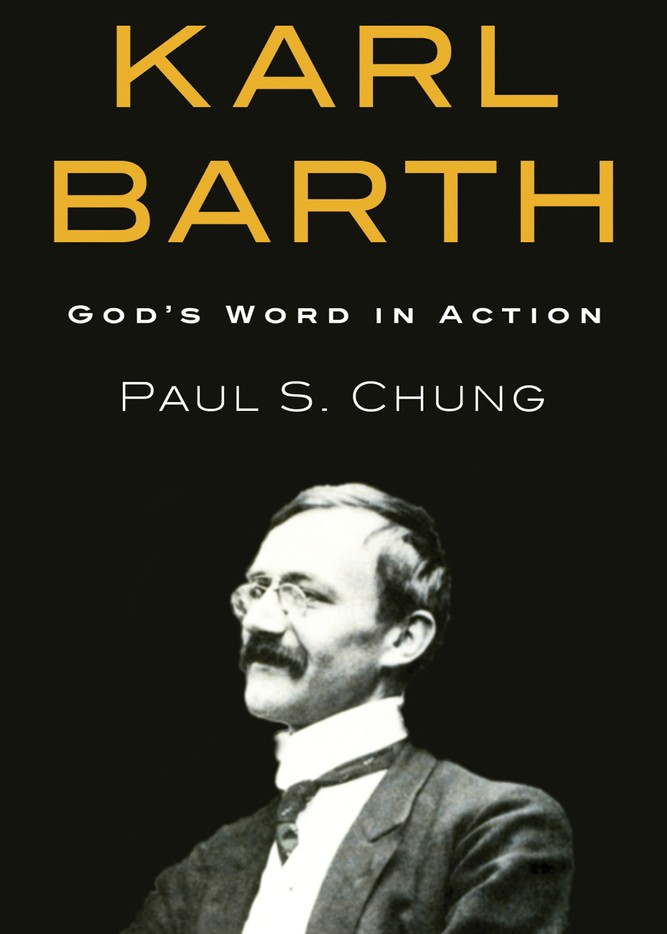
Paul S. Chung. Karl Barth: God’s Word in Action. Eugene, OR: Cascade Books, 2008. xv and 504 pages. $55.00.
If Karl Barth’s Epistle to the Romans was “the bombshell that fell into the playground of the theologians” (Karl Adam), this treatment
of Barth’s theology by Paul S. Chung reminds us why we still need to take cover. Chung locates Barth in space and time by a thorough-going
socio-economic, political, and historical reading of his legacy. This approach is a refreshing corrective to those interpretations that have
become preoccupied with Barth as a representative of neo-orthodoxy, treating his work as a kind of scholasticism apart from its Sitz im Leben
(concrete context).
Following the line of Friedrich-Wilhelm Marquardt (to whom, with Timothy Lull, the book is dedicated) and Helmut Gollwitzer, Chung
argues that one can understand neither the young Barth (whose photo adorns the cover) nor the Church Dogmatics without careful attention to
Barth’s core political commitments. These commitments were defined already when Barth served as a pastor in Safenwil (1910-1918), as he
appropriated his own form of religious socialismfrom the likes of Friedrich Naumann, Hermann Kutter, Leonard Ragaz, and thereby from the elder
Johann and younger Christoph Blumhardt. Barth not only defended Swiss religious socialism in his writings of the period, but was himself a political
activist for the cause.
Chung insists, however, that Barth took this stand for theological reasons, because God takes a stand on behalf of the oppressed classes:
“…Barth’s socialism can be expressed theologically and eschatologically in light of the kingdom of God or the absolute Revolution of God.
His socialist praxis, therefore, maintains a theological character and contour.” [p. 112].
These involvements are documented in painstaking detail with reference to Barth’s writings.
Chung carries forward his politico-theological hermeneutic for interpreting Barth to his exposition of the Tambach Lecture (1919),
the first and second editions of the Römerbrief (1919/1922), and all the way through the Church Dogmatics:
What is important for Barth is to engage in the praxis of liberation and the struggle for establishing the precondition
of the world revolution of God in solidarity with the poor and oppressed in the process of revolution. Barth’s political eschatology
is not merely future oriented but concretely involves a praxis of liberation that remains faithful to the radical, permanent revolution of God.
This divine revolution is constantly in pursuit of new social justice and order in light of the breakthrough of the kingdom of God in the world. [p. 146]
One of the points which led to the distancing of Barth from certain forms of socialism was the advocacy of violence. Barth increasingly opposed
the use of violence for provoking social change, except in very particular instances. In place of aligning theology with any particular political movement,
Barth began to articulate “the social-parable character of the kingdom of God, in which the divine stands in analogous relation to the worldly.” [p. 180].
By radicalizing his understanding of God’s revolution, Barth established it as the criterion and critique of all human revolutions.
This dialectical-analogical approach becomes one of the defining characteristics of the second edition of the Romans commentary, stressing
(with Kierkegaard) the infinite qualitative distinction between eternity and time, and recurs at key junctures in the Church Dogmatics.
In addition to his careful reading and commentary on the Barth corpus, Chung selects for special attention central themes which have been
underappreciated in Barth studies.
Three of these are of particular importance: Barth’s use of the theology of Martin Luther, the place of the Jews in Barth’s theology, and the
relationship of Barth’s theology to the discussion of religious pluralism. Chung argues that Martin Luther played a decisive role in the development
of Barth’s theology.
This is especially evident in the centrality of Christology to Barth’s thought and his reliance on Luther for the development of Christological themes.
Chung details how Barth draws from Luther (in preference over Reformed theology) in his articulation of the two natures of Christ, for example,
regarding the communicatio idiomatum of the two natures and the understanding of the ubiquity of Christ.
Even more, Barth is heavily indebted to Luther for his articulation of the theology of the cross:
“It is in the passion, suffering, and death of Jesus Christ that we encounter the act of God for us” [p. 354].
This is further developed by Barth in his claim that Jesus Christ is “the mirror of the fatherly heart of God,” which is closely
related to “the Jewishness of Jesus of Nazareth” as “the mirror of the Godhead of the God of Israel” [p. 357].
One of the most important contributions of Barth for the post-Holocaust reconstruction of Christian theology was his insistence that theology be grounded upon the God of Israel and the irrevocable election of the Jews as God’s people.
Through the election of Jesus Christ, the Jew, God’s election of the Jews becomes the election of all people.
Following Marquardt’s interpretation of Barth, Chung recalls Barth’s statement in Church Dogmatics IV/3:
“In relation to Synagogue, there can be no real question of ‘mission’…Mission is not the witness which it owes to Israel” [p. 414].
To the end of his career, Barth continued to refine his appreciation for Judaism, including affirmation of the restoration of the State
of Israel as an act of God. The fulfillment of God’s plan for Israel—the restoration of all people into the divine covenant for the sake of Jesus
Christ—awaits eschatological resolution.
Chung’s own original contribution to current theological discussion becomes most evident in his concluding chapter, “Karl Barth and an Unfinished
Project for Religious Pluralism.” A theology of the world religions remained fragmentary in Barth’s published work, yet Chung detects
significant direction for the elaboration of such in Barth’s capacity “to recognize from a theocentric, irregular perspective the strange voice of God
outside the walls of Christianity…”: “God may speak to us through Russian Communism, a flute concerto, a blossoming shrub, or a dead dog
(Church Dogmatics I:1: 55)” [p. 452].
Here Chung emphasized Barth’s “irregular dogmatics” which made room for God’s appearing behind masks and speaking through parables
of the kingdom. God’s light may choose to shine through the Scriptures and teachings of other religions.
Chung pays particular attention to Barth’s interest in Pure Land Buddhism as one of God’s strange voices through which we discover parables
of the kingdom [cf. p. 467].
Barth sees the early church’s teaching about the logos spermatikos as an antecedent for these irregular signs of God’s presence in the traditions
of other religions. However, according to Barth, these signs continue to be normed by the revelation of God made explicit in Jesus Christ.
Paul Chung in this book brings the Barth legacy to life for addressing many of the most urgent theological questions of our time:
the relation of Christian faith and politics, liberation praxis, post-Holocaust relations between Jews and Christians, and the challenge of
religious pluralism.
Within a brief period of time, Chung has burst forth on the scene as one of the most provocative and prolific theological authors in the first
decade of the 21st century. Shaped by the great figures of the Reformation, educated by 20th century European theology, and developing his
perspectives in the North American context (now as a professor at Luther Seminary), Chung is opening vistas to creative theological exchange
with other religious traditions, especially those of Southeast Asia.
This is a book that will provoke Barth scholarship and stir up the theological imagination of readers to engage the most urgent questions of our time.
Craig L. Nessan, Wartburg Theological Seminary