Raymond Carr, PhD, Advisor and Member in the Editorial Committee, International Public Theology in Forum Center
Research Associate, Moses Mesoamerican Archive and Research Project, Harvard University, Director, Codex Charles H. Long Papers Project, President of the Society for the Study of Black Religion (SSBR)
Dr. Carr is an international public theologian whose research interests are theologically ecumenical, historically sensitive, and radically inclusive. His work bridges the gap between systematic theology and black religion. To learn more about Raymond visit www.raymondcarr.com and https://ssbr1970.com/president.
Photo by Caroline Cataldo
Joi and Raymond Carr joined Harvard Divinity School (HDS) this academic year as visiting professors. Their work at the School includes exploring the story, content, spirit, and influence of Long’s intellectual work through his papers—the Codex Charles H. Long Papers Project. As part of their effort, they have organized a symposium “The (Re)Imagination of Matter: Introducing the Codex Charles H. Long Papers Project,” focusing on Long’s work.
From Exploring the ‘(Re)Imagination of Matter’ and Charles H. Long
HDS: You both are visiting professors at HDS this academic year. Tell me about yourselves, your research interests, and what attracted you to HDS?
Joi and Raymond Carr: First, let us say that we have had a wonderful semester here at HDS. It has been invigorating and insightful to see behind the veil of what existed in our minds about the mythic dimensions of “Harvard.” We now know and appreciate the real people who continually make magic happen here. This second sight into Harvard has been refreshing and leaves our imaginations filled with possibilities. And while Cambridge, especially during this time of year, does not have the kind of weather we enjoy in Malibu, California, the warm intellectual climate here makes up for the weather.
We also thank Dean David Hempton, who had the foresight to support this project. This is his last year as Dean of HDS, and we hope our efforts honor his service. This symposium is a gesture that witnesses to the insight and leadership of Hempton, who has worked effectively to enlarge the presence of African American studies at HDS. We are also fellows at the HDS Center for the Study of World Religions (CSWR), which falls under the guidance of Charles Stang. He is doing an excellent job and has made the Center a welcoming space for us. The CSWR is wonderful community, and we enjoy the cozy proximity to HDS.
Theology of Life-script
Raymond Carr: I am from a small town called West Petersburg, Virginia. My theological and religious sensibilities emerge ultimately out of that African American working-class community. I am a veteran of the United States Air Force, and I served as an Assistant Professor of Theology and Ethics at Pepperdine University, an appointment which included international visiting assignments in Heidelberg, Germany; Lausanne, Switzerland; and Shanghai, China. My research interests are theologically ecumenical, historically sensitive, and radically inclusive.
In terms of interests, my work bridges the intersection between theology and religion. I am concerned with what is technically called a theologia religionum, a theology of religions. This language can be interpreted as a shorthand way of describing the relationship between “dogmatic” interests of theologians like Karl Barth, Paul Tillich, and James Cone on one hand, and the religious interests of thinkers like Rudolf Otto, Mircea Eliade, and Charles H. Long, and Toni Morrison on the other.
I approach such discussions in a unique way by appealing to the musical aesthetics and thinking of Thelonious Monk, the High Priest of Bebop, to inform my thinking, teaching, and writing about these topics. Monk’s mode of approaching and performing jazz functions as a medium for my way of exploring the relationship between religion and theology.
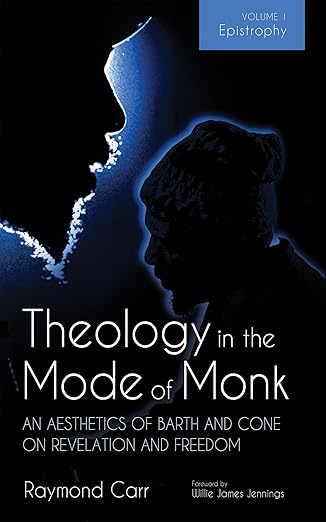
I will have a multivolume work released on the topic by the end of the year. The series is called Theology in the Mode of Monk: An Aesthetics of Barth and Cone on Revelation and Freedom. The first volume is subtitled Epistrophy; the second is Round Midnight; and the third is Misterioso. I refer to these volumes as Monk’s theological discography. I also have two other monographs Signifying Monk and Credo: In Monk Mode under contract and in progress.
Raymond Carr published a three-volume project!

Dr. Raymond Carr (PhD, Graduate Theological Union, Berkeley) is a research associate and director of the Codex Charles H. Long Papers at the Moses Mesoamerican Archive at Harvard University, as well as the president of the Society for the Study of Black Religion (SSBR). He is an international public theologian and serves on the committee for International Public Theology at the Forum-Center in Berkeley.
Dr. Carr engages two of the most influential theologians of the twentieth century: Karl Barth, who constructed his theology “from above,” and James H. Cone, who constructed his theology “from below.” Barth’s struggle against Nazism and his political engagement in the public sphere are juxtaposed with Cone’s confrontation with white racism in American public life.
In this three-volume project, Carr employs the aesthetic thinking of jazz legend Thelonious Monk to reimagine, restructure, and advance the theologies of Karl Barth and James H. Cone in light of a critically constructive, experiential public theology. Interestingly, Wolfgang Amadeus Mozart—central to Barth’s theological imagination—encounters Cone’s spirituals and blues while finding their resolution in Monk’s jazz as a form of analogical witness to the kingdom of God, made present through the resurrection of Jesus and the power of the Holy Spirit.
In the first volume, Carr draws on the Bebop tune Epistrophy as an analogical framework for reconstructing the socio-historical Sitz im Leben and hermeneutical thrust of Barth and Cone within a broader spectrum, for the sake of intertextuality.
Professor Willie James Jennings of Yale Divinity School offers the preface, naming the mode of transformation at the heart of Carr’s work. Carr seeks transformation through the incarnation—assumptio carnis—within a Barthian radical mode of thought, interpreted through Cone’s theologia crucis and the symbol of the lynching tree.
Musicality becomes the mode of being through which God meets us in times of trouble and distress. This resonates with Barth’s understanding of the gospel as viva vox evangelii—the living voice of the gospel—which must be sung and proclaimed in an irregular manner. God’s speech act (Wort-Tat) comes to us in a chaotic, even guerrilla-like style, outside the traditional walls of the church (Extra Muros Ecclesia), as exemplified and radicalized in the prophetic school of Berlin through figures like Helmut Gollwitzer and F. W. Marquardt.
Beyond that, Carr draws on the work of the great historian of religion and Black phenomenologist Charles H. Long, who provides a phenomenological lens through which to reread Barth and Cone. Carr writes in a marvelously interwoven reflection: “Karl Barth improvised on the subjective experience of the subject matter, whereas Cone improvised on the subjective experience of the subject matter.” While Barth sought to establish a theoanthropology, as expressed in The Humanity of God, Cone articulated a distinct theoanthropology in The God of the Oppressed.
That said, Barth’s Christological thinking—grounded in the assumptio carnis in its collective sense (Gattungswesen, in the language of left-wing Hegelianism à la Feuerbach)—cannot be fully understood apart from his seminal idea of theoanthropology, articulated through the concept of God’s humanity in accordance with the analogia relationis.
Carr’s major contribution lies in reconstructing the relationship between revelation and experience. He highlights how Barth critically engages with sociopolitical and cultural-religious regimes as problematic thresholds in understanding revelation and Scripture—since revelation, as the third form of the Word of God, takes priority over both Scripture and preaching. Carr challenges the American stronghold of Barthian Neo-Orthodoxy, cutting through even the critical-realist and dialectical interpretations of Barth. He aligns instead with George Hunsinger’s postliberal reading, advancing it in a distinctly sociopolitical and experiential direction.
George Hunsinger, a renowned Barth scholar and Professor of Systematic Theology at Princeton Theological Seminary, characterizes Carr’s aesthetic-irregular approach to Barth and Cone:
“Raymond Carr has emerged as one of the most creative minds in contemporary African American theology. His intensive engagement with James Cone and Karl Barth has already made a mark in the field, but that impact is now assured with the appearance of these remarkable volumes.”
I believe Dr. Raymond Carr is a heuristic and inspiring thinker, undertaking an audacious attempt to restructure irregular phenomenological theology in an aesthetic mode. In doing so, he synthesizes Barth’s thought-form “from above” with Cone’s experiential theology “from below,” moving toward a dialectical-analogical theology of the theological subject matter, in continuity with the prophetic tradition of Helmut Gollwitzer and F. W. Marquardt as well as Black experiential theology in the mode of Monk.
A logos of society, in other words, Jesus as the partisan for the poor or massa perditionis (ochlos-minjung), finds its pivot in the Black experience of sociopolitical struggle against racism. In Carr’s interpretation, I sense that Barth appears to be a theologian of God’s speech event both from above and from below, more so from the Other, in a phenomenological mode à la Emmanuel Levinas.