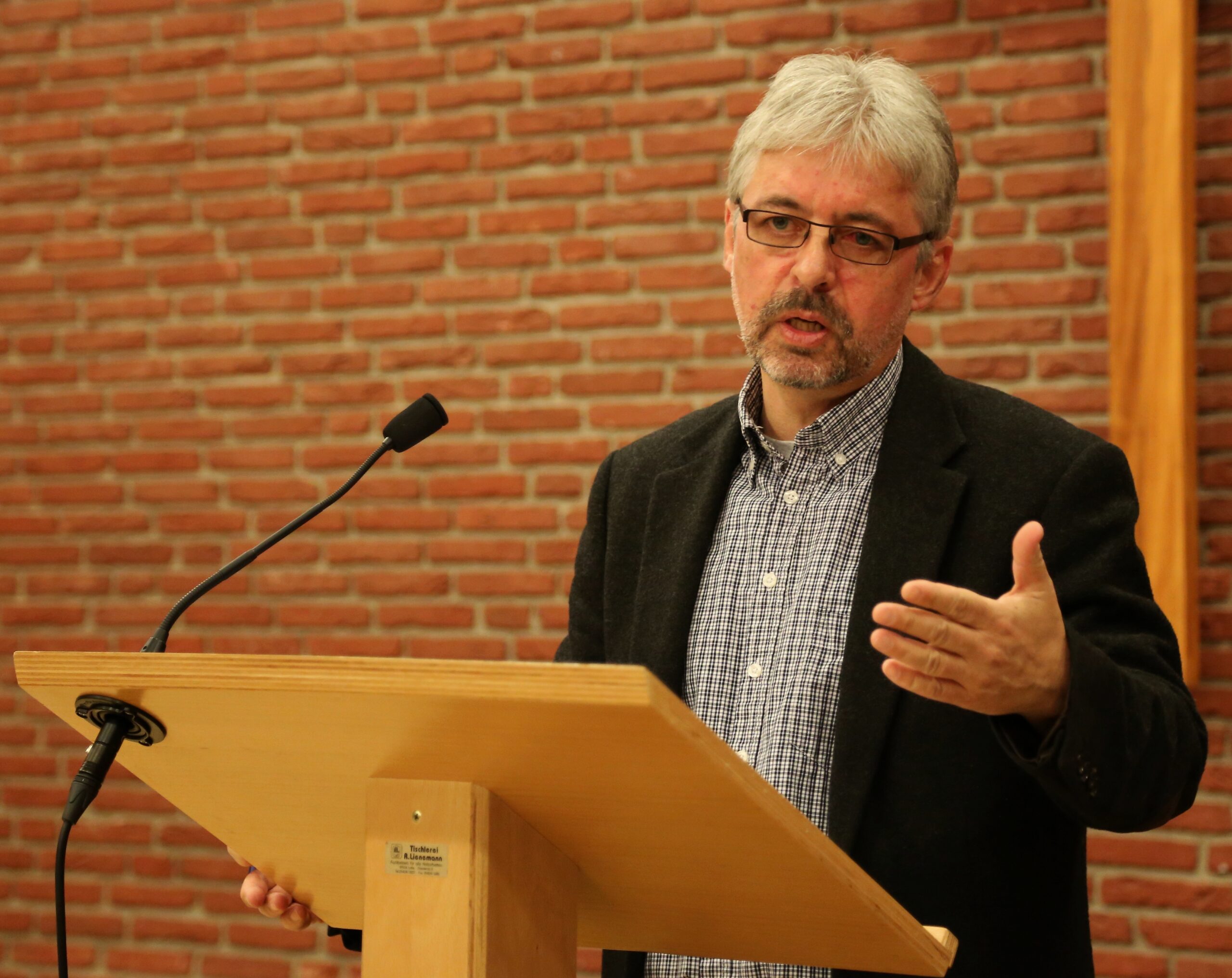
Paul S. Chung’s Interview with Prof. Dr. Traugott Jähnichen
Paul Chung takes the opportunity to interview Prof. Dr. Traugott Jähnichen at Evangelisch-Theologische Fakultät Ruhr Universität Bochum, Germany. Our International Public Theology in Forum is excited to work together with Prof. Jähnichen in the near future to promote public theology and democracy of civil society, eco-justice, and integrity of the life-world.
Today’s situation of crisis becomes acute in the Ukraine war and the pathology of late capitalism in a neoliberal economic system, as was brought by the capitalist revolution (Helmut Gollwitzer).
Prof. Jähnichen specializes in the field of Christian Social Theory and economic ethics, and teaches this academic discipline in connection with ethical basic relations and in terms of social institutions. His research project is featured as cross-disciplinary and an intercultural engagement across a diverse spectrum.
Jähnichen involves dialogues with sociology and other human sciences to emphasize ethical responsibility and renew social structure in accordance with the biblical prophetic tradition of Christian faith, confronting crises and challenges of today’s global situations.
Along with the marching progress of globalization, technological rationality and its achievement prevail by undergirding the functional differentiation of society. Western society is characterized in its cultural pluralism and racial hierarchy within social stratification (seen in current immigration politics in USA and Europe and the sociobiological revival of old social Darwinism).
Given this, it is a pressing issue for Christian Social Theory to take into account social integration of late modern society. Christian social ethics needs to incorporate significance of the world and life in accordance with Biblical witness and Christian tradition, bringing its power of social formation and ecological sustainability into effect.
Appreciation
Traugott Jähnichen is committed to actualizing Christian sociology and embodying Christian faith as praxis of discipleship in the public sphere of late modern industrial society, as well as challenging neo-liberal systems of world economy. He brings the ethical tradition from Martin Luther to Helmut Gollwitzer into a prophetic profile of social Protestantism; the grace of justification cannot be understood without its social ethical consequences. His contribution consists of ethics of world economy and prophetic Diakonia of the church for civil society, democracy and social justice.
Publications (select)
Die Ethik Martin Luthers, Bielefeld 2017 (gemeinsam mit Wolfgang Maaser)
Dietrich Bonhoeffer – Life and Legacy, Traugott Jähnichen/Pascal Bataringaya/Olivier Munyansanga/Clemens Wustmans (Eds.), Zürich 2019
Wirtschaftsethik 4.0. Der digitale Wandel als wirtschaftsethische Herausforderung, Stuttgart 2020 (gemeinsam mit Joachim Wiemeyer)
Overcoming Violence. Challenges and Theological Responses in the Context of Central Africa and Europe, edited by Pascal Bataringaya/Claudia Jahnel/Traugott Jähnichen/Penine Uwimbabazi, Zürich 2021
Ecological Justice. Churches as civil-society-stakeholders: perspectives from Africa and Europe, hg. von Claudia Jahnel und Traugott Jähnichen, Oer-Erkenschwick 2022
Evangelischer Glaube in der pluralen Religionskultur der Moderne. Fundamentaltheologische Perspektiven, Stuttgart 2023

Interview: Traugott Jähnichen and Public Theology
Clarification: Christian Social Ethics and Ethical Theology
You are an expert in the field of Christian Social Theory (CST), which is concerned with the ethical relation in dealing with social institutions and exploring a possibility of new social formation. Would you give us more explanation about an interdisciplinary character of CST and its ethical evaluation? What differentiates CST from ethical theology (Trutz Rentorff), which is known in American academies? How does Christian sociology take issue with a generically deterministic view of human life justifying racial injustice, sexism, and social cultural inequality (Richard Dawkin’s selfish genes and E. Wilson’s Sociobiology)?
Traugott
Christian social theory or more precise: Christian social ethics reflects the institutional aspects of human action. It is less about, as in ethical theology, showing the anthropological dimension of action and its theological background beliefs. Rather, Christian social ethics wants to draw attention from a critical perspective to the fact that and how historical constellations, social structures or cultural knowledge shape people’s self-image and their relationships with other people and the world around them. It is about critically measuring these conditions against the standard of the Gospel and making the normative impulses of the Bible, in particular the basic attitude of loving one’s neighbor and the biblical conception of justice, fruitful in society. Racism, social Darwinist concepts, sexism, classism or ableism must be deconstructed from this perspective and overcome through appropriate impulses for action.
Relevance: Christian Social Ethics and Public Theology
How do you relate CST to public theology? In American context, public theology has a diverse spectrum in its approach to the public sphere in civil society, common good governance, and theology of nature, recognition of multiculturalism, or religious pluralism among others. How do you characterize CST in regard to public theology, civil democracy, and dialogue with other religions?
Traugott
Christian social ethics is an important part of “public theology” or public Christianity. While “Public Theology” reflects all of the effects of Christianity in the public sphere – including in the area of culture – the task of CSE is primarily aimed at bringing socially relevant impulses from Christian responsibility into the areas of politics and economics. Networks in civil society are therefore just as relevant as interreligious dialogues.
Interaction: Local and Global Contexts
How do you view the dialectical relationship between the local or contextual responsibilities for the public theology, while contributing to the wider context of global political, economic, and communication forces? How would you, a Christian sociologist and public theologian, participate in your local issues as well as an ecumenical commitment?
Traugott
Ethical reflection always has to reflect on its contextual conditions and develop answers to the challenges of specific regional and national contexts. Since these are often determined by the transnational or global level (particularly when it comes to economic and ecological issues), it is necessary to include this level in both the analysis and the recommendations for action, in a bottom-up model. Ecumenical and interreligious contacts are anchored and relevant in the regional world. At the (trans)national level, the global institutions for such cooperation and dialogue must be strengthened and the work should be made more concrete through references to regional levels.
Faith as Praxis of Discipleship
How do you articulate the significance of faith as praxis of discipleship for the public sphere in global situations (for instance, Ukraine war and crisis or legitimacy of late capitalism in a global system of the world economy). In American context I find it significant to develop public theology in dealing with racial issues, neo colonialism. and politics of recognition (Charles Taylor). How would you conceptualize these problems from the standpoint of Christian Social Theory?
Traugott
Christian faith influences not only personal but also public life. In modern, pluralistic societies, a central challenge is to promote a deeper form of tolerance, i.e. not only to tolerate other religions and world views, but to recognize them as long as they respect basic human rights. If the rights of others are questioned or rejected, as racist positions do, this must be resolutely contradicted and defended through laws.
Through partnerships between churches in the Global North and the Global South, ecumenical learning must be promoted that enables mutual enrichment in intercultural exchange and the development of joint social and ecological projects.
Contribution
Our International Public Theology in Forum-Center (IPTFC) is based on the global network and ecumenical church relations, promoting public theology and social scientific studies of civil democracy and life-world to engage with science-religion dialogue, life-sciences, and ecological sustainability. Would you explain what kind of contributions you would foster in collaboration with us? What kind of programs does your school have or plan to strengthen international exchanges?
Traugott
The Ruhr University Bochum promotes the concept of sustainability, and all faculties contribute to it. There have been projects on ecological justice in the Protestant Theological Faculty for several years. Specifically, it is about questions of ecological justice in the dialogue between churches and universities in the North and the South. The question of justice for non-human creatures also plays an important role. I could contribute these aspects to the Seoul conference in 2026.