Luther against the Jews: The Ethics of Historical Interpretation
Craig L. Nessan
Wartburg Theological Seminary
Dubuque, Iowa, U.S.A.
When you visit the U.S. Holocaust Memorial Museum in Washington, D.C., the opening film prominently quotes Luther’s disastrous writings against the Jews, citing from his recommended measures to destroy synagogues, schools, and homes; take away prayer books and Talmud; forbid rabbis from teaching; abolish safe conduct on the highways; and expel Jewish persons from their communities. Only if you watch the credits at the end of the film, which virtually no one does, might you note the response of contemporary Lutherans to these writings. For how many persons is the primary impression they have of Martin Luther his writings against the Jews?
Luther’s writings against the Jews call into radical question not only his ethics but his entire theology.[1] The ethical integrity of the Protestant Reformation becomes severely questionable if the conclusions drawn by Luther in his writings against the Jews are not repudiated. Where did Luther go wrong? Is it possible to draw upon Luther’s own theological arguments to arrive at other conclusions? One key for interpreting, criticizing, and deconstructing Luther’s thoughts involves unmasking how intolerance of the religious other undermined the foundations of Luther’s own neighbor politics (not only in the writings against the Jews but also those against Anabaptists and the peasants).
Whereas the work of the historian—in spite of widespread discussion of the question whether interpretation without presuppositions is possible—continues to demand rigor in the practices of investigating sources and interpreting them accurately, the ethical challenge becomes acute when particular topics within historical study cry out for the historian to suspend a stance of neutrality and demand ethical judgment. The first ethical decision involves the choice for research of a particular topic. The choice to investigate Luther’s writings about and against the Jews is in itself a decision that carries ethical import. This is closely related to the hermeneutical decisions about how to frame and organize one’s research agenda. Most importantly, there is ethical judgment regarding if and how to make commentary on the significance of one’s findings.
My argument is that Luther’s writings against the Jews, not only because of their specific content but also because of the trajectory of their subsequent interpretation, require honest and explicit ethical discernment and decision on the part of historians. The rite of confession and forgiveness between the Lutheran World Federation and the Mennonite World Conference in 2010 is one instance of how historical research leads to the imperative of ethical judgment. Seeking to preserve neutrality on the part of historians in such cases is an ethical omission of great consequence, leading not only to misunderstanding but contributing to scandal.
Interpreting Luther’s Writings against the Jews
The conventional view — that Luther began his career with certain openness and generosity to the Jews in anticipation of their conversion to the gospel, who only later in life turned toward animosity and hatred against them — is demonstrably false. This conventional view has been and continues to be perpetuated by major scholars working on the theme of Luther and the Jews.[2]
This conventional interpretation has been challenged and refuted by recent scholarship, which holds that Luther was consistent throughout his career in operating out of the paradigm that the Jews were an apostate people who had been in exile from God for 1500 years.[3]
At no point in his career does Luther ever express hope for the Jew as a Jew. Judaism is a dead religion, and Luther makes no distinction between Judaism and those who practice it, the Jews. What he says about the one applies to the other. What he does express, in varying degrees, is a hope for the Jew to become a Christian. The phrase “Jew-friendly Luther” only makes sense if it refers to the degree of openness to or optimism about Jewish conversion to Christianity.[4]
From his earliest writings onward, Luther demonstrated contempt for the Jewish people, not only on biblical grounds but because of his conviction that they had rejected Jesus as the Christ not only in the New Testament but conclusively in rabbinic Judaism. This verifies Maurer’s claim that the “post-biblical Jew is the archetype of the human being standing in opposition to God.”[5] Although one could not have predicted that his utterances against the Jews would lead finally to Auschwitz, the legacy of anti-Semitism fueled by his writings and perpetrated by his followers is the most disastrous of all Luther’s ethical missteps.
By way of example, we consider Luther’s 1515-1516 Lectures on Romans (LW 25), specifically the theologically significant chapters 9-11, which provide compelling evidence not only by what Luther says but especially on the basis of what he fails to say. Major theological claims by Luther include:
- Prior to his conversion, Paul “wanted to be in agreement with the Jews, who made Christ anathema to themselves and cast Him out of the city and out of their communion and killed Him and declared themselves chosen and established themselves” (LW 25:380).
- Paul “wishes the greatest salvation also for the Jews, and in order that they might have this, he freely is willing to lose his own salvation” (LW 25:380).
- Regarding 9:6 “For not all who are descended from Israel” Luther comments: “This passage is opposed to the presumptuousness of the Jews and as a condition of grace, for the destruction of the haughty trust in righteousness and good works. For the Jews want to be considered the children of the Kingdom because they are the children of Abraham. Against them the apostle argues with an invincible argument, first because they themselves cannot deny its validity” (LW 25:384).
- Regarding 9:10 “But also when Rebecca had conceived by one man” Luther comments: “For the meaning is that the flesh and physical descent do not profit for the adoption as sons…How much less will it benefit the unbelieving Jews, born long afterwards, that they are the sons of the patriarchs according to the flesh, if they are without faith, that is, if they have not been elected by God!” (LW 25:385-386).
- Regarding 9:27 “Only a remnant of them will be saved” Luther comments: “Therefore in this way and in many other places the apostles and the faithful among the Jews are called the ‘remnant’ or the ‘remainder’, even the ‘dregs of the people of Israel,’ as if the better and larger part of them were going to perish. So also now the Jews have gone into the true Babylonian exile of unbelief; all the noble ones, with only a few left behind” (LW 25:395-396).
- Regarding 9:28 “For He will finish His Word and cut it short in righteousness” Luther comments” “For before this Word of faith, the Word of the Spirit, was revealed, everything was in shadow and figure because of the slowness of the Jews; the Word was unfinished and incomplete and therefore easily understood by all, because it spoke in figures by things that could be perceived by the senses…It was an imperfect word because it signified but did not demonstrate that which it signified. And for this reason it was extended and prolonged, because it led more and more to the imperfect and the carnal, since it was impossible for it to exhibit what was spiritual as long as it was considered and understood in a carnal way” (LW 25:396, 398).
- Regarding 10:2 “They have a zeal for God, but it is not enlightened” Luther comments: “Therefore ‘to have an enlightened zeal’ is to know nothing about that for which one is zealous. For to know that one does not know, this is the kind of knowledge according to which the Jews have no zeal” (LW 25:405).
- Luther refers in commenting on 10:14 and in other places to “Jews, heretics, and schismatics” (LW 25:413), making the Jews paradigmatic for those who have fallen away into false belief. Another example: “…the Jews, heretics, and monks, that is, arrogant individualists, worship the true God according to their own ideas with most ridiculous zeal; with their excessive piety they are worse than the most ungodly, that is, for the sake of God they come to despise Him, for the sake of piety they become impious, for the sake of peace, disturbers of the peace, for the sake of love and holiness, jealous and profane, and for the sake of humility they become proud” (LW 25:422).
- Regarding 11:1 “I myself am an Israelite” Luther employs Paul as an instance of a Jew who belongs to a remnant saved by God: “He has proved this by my example, for He did not reject me; therefore much more He has not rejected others, who have not gone as far away from Him as I had” (LW 25:421).
- Regarding 11:9 “Let their feast become a snare” Luther comments: “But it is a ‘pitfall’ because those who have been caught continue to stumble without ceasing. For they are trapped in those things which they understand falsely; for they cling to these ideas and find pleasure in them and thus are willingly captured by them, but they do not know it” (LW 25:425).
- Regarding 11:11 “But through their trespass salvation has come to the Gentiles” Luther comments: “That is, salvation to be sure has come to the Gentiles by the fall of the Jews, in order that their fall might not entirely be barren of fruit and an evil thing without any good; since for the saints all things work together for good, how much more in the case of Christ and God do evils work out for good!” (LW 25:426). Luther elaborates here and in commenting on following verses how the defiance of the Jews has allowed for blessing to the Gentiles (LW 25:426-429).
- Regarding 11:25 “I want you to understand” Luther comments, drawing on the analogy of Joseph sold by his brothers into slavery in Egypt: “So also the Jews who threw Christ out to the Gentiles, where He now has the position of ruler, will finally come back to Him, drawn by hunger for the Word, and they will receive Him among the Gentiles” (LW 25:430). Luther defends an eschatological deliverance of the Jews: “Therefore Christ has not yet come to the Jews, but He will come, namely, at the Last Day, as the writers above show. Thus it is necessary that we interpret the apostle as speaking of the mystical coming of Christ to the Jews…Thus in our time ‘a partial blindness has befallen Israel,’ but in that future day not a part but all Israel shall be saved. Now only in part are they saved, but all shall be” (LW 25:430-431).
- Regarding 11:29 “For the gifts of God are irrevocable” Luther comments: “This is a remarkable statement. For the counsel of God is not changed by either the merits or demerits of anyone. For He does not repent of the gifts and calling which He has promised, because the Jews are now unworthy of them and you are worthy” (LW 25:432).
Summarizing Luther’s argument: Jews are counted as apostates and categorized with heretics and schismatics as those who have fallen away from God. Paul himself is cited as a Jew who has received the Gospel of Jesus Christ, paradigmatic of what is hoped for all Jews. The Abrahamic and Mosaic covenants are insufficient for Jewish deliverance; the Jews have entered into a Babylonian Captivity of unbelief. Through the fall of the Jews, the Gentiles have received the message of salvation. Luther awaits the Last Day, when there will be a “mystical coming of Christ to the Jews.” Although he states that the gifts of God are irrevocable, Luther indicates shallow expectation for this to happen before God’s extraordinary intervention at the eschaton.
The Trajectory of Luther’s Writings against the Jews
What Luther, like other interpreters over the course of church history, does not say relates to the force of Paul’s argument in Romans 11:17-26a. How might the history of interpretation been redirected if first Paul and subsequently other interpreters, including Luther and other significant figures, really understood that the promises of God to Israel are irrevocable and that the Gentiles are branches grafted onto a living olive tree through Jesus, the Jew? It is a tragedy of unmeasurable proportions that only after the Holocaust have some few Christian theologians begun to interpret this passage with charity toward the integrity of Israel’s role in extending God’s promises also to the Gentiles.[6]
The force of Luther’s public testimony against the Jews took on a life of its own over the centuries. The path leading from Luther to Kristallnacht and Auschwitz is long and twisted. But one can arrive there from here. One major factor involves the immense stature of Luther as an authority figure for all of German and Protestant history. Each generation has tended to project upon Luther its own agenda, in order to claim his authority for its purposes.[7] This phenomenon is complicated by Luther’s thoroughgoing Christian interpretation of the Old Testament, which distorts the historical character of the Hebrew Bible as an inherently Jewish book.
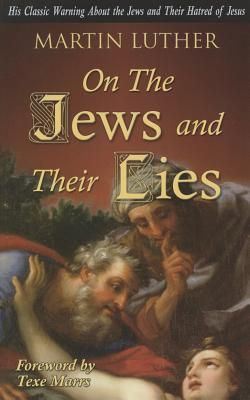
In the time immediately following the Reformation into the seventeenth and eighteenth centuries, there are two distinguishable trajectories regarding the interpretation of Luther in relation to the Jews. First, among orthodox theologians there was a tendency to appeal to Luther’s later treatise, On the Jews and Their Lies, to argue for the Christianization of society and the suppression of Jewish existence according to Luther’s most severe measures. Second, in the Pietist traditions, there was a tendency to appeal to Luther’s earlier treatise, That Jesus Christ Was Born a Jew, to mobilize attempts to convert Jews to the Christian faith. While the latter was in many respects less violent, it still negated the integrity of Jewish existence. In the eighteenth and nineteenth centuries, there emerged an Enlightenment portrait of Luther, who was understood to have been a defender of the Jews according to the standards of religious tolerance. Never, however, in these centuries was the anti-Jewish legacy of Luther fully suppressed.
In the late nineteenth century, aspects of Luther’s proto-racist concept (his references to “the nature of Jews”) became fused with pseudo-evolutionary thinking that categorized people according to national characteristics (Volk) and as “races.” During this period compendiums of Luther’s writings, new editions of his works, monographs, and pamphlets began to appear that progressively intensified the presentation of Luther as an anti-Semite. The case of the Institute for the Study and Eradication of Jewish Influence on German Religious Life, founded in 1939, demonstrates how extensively and with how little opposition the anti-Jewish interpretation of Christianity could prevail.[8] Jesus was depicted as an Aryan, an enemy of Judaism, as evidenced by the extensive publications of the Institute’s academic director, Walter Grundmann. As commented by Siegfried Leffler, Institute director: “So we cannot think of Adolf Hitler without Martin Luther.”[9] The conflation of Christian theology, racism, and anti-Semitism made them inseparable. The publications and speaking events by members of this Institute extended its influence broadly, lending religious and moral authority to the Holocaust, in particular the authority of Luther.
Luther served as an indispensable figure for authorizing the anti-Semitic propaganda and policies of the Nazis. In its most extreme form, Luther was cited against the church itself, which was accused of attempting to suppress the “true” anti-Semitic Luther. Kristallnacht was interpreted as the fulfillment of Luther’s prophecy. Such anti-Jewish views were shared so broadly among Christians that even in the Confessing Church (that portion of the Protestant church opposing the Third Reich”s program to Nazify the church organization and its teachings), resistance to Hitler was undermined by the prevailing anti-Semitic interpretation of Christian teaching shared by the majority of Christians in Germany.[10] Thomas Kaufmann comments:
The appropriation of Luther for eliminationist Anti-Semitism in National Socialism is an extreme consequence in the history of his interpretation. It was made possible insofar as Protestants had overestimated the worth of their icon—a treacherous constellation.[11]
What are the ethical requirements demanded of historians in interpreting the legacy of Luther’s writing against the Jews?
Repudiating Luther’s Writings against the Jews
In the post-war years the churches in Germany were slow to acknowledge and account for their failure to oppose measures against the Jews during the Third Reich. Anti-Semitic convictions continued to be perceptible in church publications and theologians who supported an anti-Jewish interpretation of Christian teachings during the Nazi era continued to teach and publish. Gradually, regional church bodies began to issue statements confessing guilt in relation to Luther’s writings and validating God’s inviolable covenant with Israel, breaking from Luther’s legacy. In 1983, at the five hundredth anniversary of Luther’s birth, the Council of the Evangelische Kirche in Deutschland (EKD) declared Luther’s late anti-Jewish writings as “disastrous.” However, there has been no clear repudiation by the EKD of Luther’s writings against the Jews.
Only in 1994 did the Evangelical Lutheran Church in America adopt a statement rejecting Luther’s anti-Jewish writings and their legacy.[12] While an official document on the part of any single church body is woefully insufficient to address the catastrophic legacy of Luther’s writings, it does provide a point of departure for the emergence of a truth and reconciliation process.
By contrast, the EKD on the very eve of the 2017 observance continued to represent a cautious and mitigating approach to Luther’s culpability in its “Declaration: Martin Luther and the Jews. A Necessary Reminder on the Occasion of the Reformation Anniversary.” This declaration perpetuates the deficient interpretation of a shift in Luther’s approach between his earlier and later career rather than making a direct repudiation of Luther’s writings against the Jews: “First he argued for a friendly, persuasive approach to Jews, and then resorted to invective, demanding that they be deprived of their rights and expelled (#3).[13] In light of the historical record and the state of current scholarship such an approach is no longer acceptable.
The case of Luther’s writings against the Jews summons historians to engage in the ethics of interpretation with extraordinary judiciousness, due to the palpable crimes against humanity committed against subsequent generations of Jews by those who appealed to his authority in carrying out their genocidal policies. Still today Luther’s writings against the Jews are employed by hate groups to justify themselves.[14]
In January 2000 Elie Wiesel, a Holocaust survivor who lost the members of his own family in the death camps, addressed the German Bundestag on Holocaust Remembrance Day 55 years after the liberation from the death camps:
President Rau, you met a group of Auschwitz survivors few weeks ago. And one of them told me that you expressed something very moving. You asked for forgiveness for what the German people had done to them. Why shouldn’t you do it here? In the spirit of this solemn occasion. Why shouldn’t the Bundestag simply let this be known to Germany and its allies and its friends, and especially to young people? Have you asked the Jewish people to forgive Germany for what the Third Reich did in Germany’s name to so many of us? Do it, and it will have extraordinary repercussions in the world. Do it, and the significance of this they will acquire a higher dimension. Do it, and the world will know that its faith in this Germany is justified.[15]
In response to this plea President Johannes Rau already in February 2000 addressed the Israeli Knesset:
I am asking for forgiveness for what Germans have done, for myself and my generation, for the sake of our children and grandchildren, whose future I would like to see alongside the children of Israel.[16]
While this symbolic act was criticized by many, one could argue that it was decades overdue.[17]
This act of contrition and request for forgiveness provides a frame of reference for considering the responsibility of Christians to engage in contrition and ask for forgiveness for the acts of hostility and crimes against humanity perpetrated by Christians against the Jewish people over the centuries, as comes to paradigmatic expression in the trajectory of hatred and acts of violence to which Luther’s writings have so significantly contributed.
For this reason it is imperative to pose a critical question about the assumption of a stance of neutrality by historians in relation to Luther’s writings against the Jews on the occasion of the 500th anniversary of the Reformation. For example, the Scientific Advisory Board for the Reformation Jubilee 2017 of the EKD writing in 2014 continued to present, against evidence, the conventional paradigm that distinguishes between an early Luther, exemplified by “That Jesus Christ was Born a Jew” and the later Luther, exemplified by “Against the Jews and their Lies.” In The Reformation and the Jews: An Orientation, the authors provide an historical assessment that concludes:
It is difficult to say what role the treatise Concerning the Jews and their Lies played in the widespread anti-Semitism among German Protestants. The sources of their anti-Semitism lie elsewhere. Yet Luther’s hostility to Jews may well have confirmed German Protestants in their anti-Semitism and dulled their sensitivity to its deadly consequences….
On the one hand, the unfathomable crime of the “Final Solution” cannot be traced back to Concerning the Jews and their Lies, for the final objective of Luther’s treatise was not mass murder but expulsion and its arguments were not racial politics but religious. Hence, that Nazis and German Christians made appeals to its text is beside the point. On the other hand, Concerning the Jews and their Lies was useful for Nazi propaganda because it, too, demonizes the Jews and insists that governments should create lands without them. An anniversary of the Reformation which reflects on the full range of the heritage left by this historical turning point cannot keep silent about such a burdensome legacy.”[18]
In light of the well-documented appeal to Luther’s writings to justify genocide in German biblical studies, church history, and theology in the late 19th and especially 20th century, this claim in an official publication of the EKD is not only astonishing but stunning. The equivocation in argument and absence of ethical reflection and judgment is beyond comprehension.
The questions raised in this article involves the adequacy of seeking to preserve a stance of ethical neutrality on the part of historians in response to both the content and historical trajectory of Luther’s catastrophic writings against the Jews. In the spirit of Wiesel I pose the question: On this solemn occasion, why should not the EKD simply repudiate Luther’s writings against the Jews? Let this be known to Germany and the ecumenical church, and especially to young people! Do it, and it will have extraordinary repercussions. Do it, and the significance of this will acquire a higher dimension.[19]
The integrity of the Lutheran witness to the faith among the growing number of atheists and religiously uncommitted persons—and even more to the global Jewish community—hangs in the balance. Not only clearly articulated repudiation of Luther’s writings against the Jews but also a systematic program of teaching about this legacy in congregations, colleges, universities, seminaries, and public forums is imperative.
[1] This article was first published in Currents in Theology and Mission 45.1 (January 2018):5-10 and is used with permission. It builds on the arguments made in the chapter, “Beyond Luther to Ethical Reformation: Peasants, Anabaptists, Jews,” in Karen Bloomquist, Craig L. Nessan, and Hans Ulrich, editors, Radicalizing Reformation: North American Perspectives (Zűrich: Lit Verlag, 2016), 151-178, and the article, “Luther against the Jews: Repudiating a Reformation Legacy,” in Tikkun (Summer 2017).
[2] For example, Eric W. Gritsch, Martin Luther’s Anti-Semitism: Against His Better Judgment (Grand Rapids: Eerdmans, 2012 and Thomas Kaufmann, and Thomas Kaufmann, Luther’s Jews: A Journey into Anti-Semitism (New York: Oxford University, 2017).
[3] Brooks Schramm and Kirsi I. Stjerna, eds., Martin Luther, the Bible, and the Jewish People: A Reader (Minneapolis: Fortress, 2012), 8.
[4] Schramm and Stjerna, eds., Martin Luther, the Bible, and the Jewish People, 9.
[5] Wilhelm Maurer, “Die Zeit der Reformation,” in Kirche und Synagogue: Handbuch zur Geschichte von Christen und Juden. Darstellung mit Quellen, 2 vols., ed. Karl Heinrich Rengstorf and Siegfried von Kortzfleisch (Stuttgart: Klett, 1968), 1:379.
[6] Cf. Friedrich-Wilhelm Marquardt, “Enemies for Our Sake: The Jewish No and Christian Theology,” Chapter 1 in Friedrich-Wilhelm Marquardt, Theological Audacities: Selected Essays, ed. Andreas Pangritz and Paul S. Chung (Eugene: Wipf & Stock, 2010), 3-30.
[7] For this and the following historical overview, see Thomas Kaufmann, Luthers Juden (Stuttgart: Reclam, 2014), 141-179.
[8] Susannah Heschel, The Aryan Jesus: Christian Theologians and the Bible in Nazi Germany (Princeton: Princeton University, 2008).
[9] Heschel, The Aryan Jesus, 283.
[10] Mary M. Solberg, A Church Undone: Documents from the German Christian Faith Movement, 1932-1940 (Minneapolis: Fortress, 2015) provides comprehensive documentation from this period.
[11] Kaufmann, Luthers Juden, 175.
[12] Evangelical Lutheran Church in America, “Declaration of ELCA to Jewish Community,” April 18, 1994, http://download.elca.org/ELCA%20Resource%20Repository/Declaration_Of_The_ELCA_To_The_Jewish_Community.pdf?_ga=1.177096485.1660177343.1378417152. The Evangelical Lutheran Church in Canada issued the statement, “To the Jewish Community in Canada,” in 1995, https://www.ccjr.us/dialogika-resources/documents-and-statements/protestant-churches/na/lutheran/682-elcic95july16.
[13] Evangelische Kirche in Deutschland, “Declaration: Martin Luther and the Jews. A Necessary Reminder on the Occasion of the Reformation Anniversary,” November 11, 2015, https://www.ekd.de/english/download/2015_synod_declaration_luther_and_the_jews.pdf.
[14] For example, see the widely distributed pamphlet, Martin Luther, The Jews and their Lies (Reedy, W VA: Liberty Bell Publications, 2004).
[15] Elie Wiesel, “Address to the German Bundestag,” January 27, 2000, https://www.bundestag.de/parlament/geschichte/gastredner/wiesel/rede/247400
[16] “German President Apologizes for the Holocaust,” February 17, 2000, http://en.people.cn/english/200002/17/eng20000217W110.html
[17] See the documentation of this historic exchange in the film by Martin Doblmeier, “The Power of Forgiveness,” First Run Features, 2008.
[18] The Scientific Advisory Board for the Reformation Jubilee 2017 (Ingolf Dalferth, Thomas Kaufmann, Dorothea Wendebourg), The Reformation and the Jews: An Orientation (2014), #24-25.
[19] Elie Wiesel, “Address to the German Bundestag,” January 27, 2000, https://www.bundestag.de/parlament/geschichte/gastredner/wiesel/rede/247400