Paul Chung: We Belong 16: Justification and Justice
Lutheran Public Theology in Dietrich Bonhoeffer, Christine Helmer, Craig Nessan, and Ted Peters
Ted Peters Jun 18
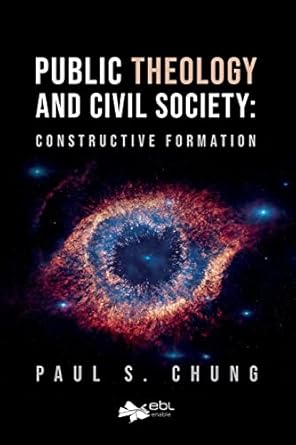
Paul S. Chung has been busy lately constructing a new bilingual website on behalf of the Public Theology in Forum 전체 글. A few years ago Paul published an almost manifesto book I admire, Postcolonial Public Theology: Faith, Scientific Rationality, and Prophetic Dialogue. More recently he has released Public Theology and Civil Society: Constructive Formation. Last year I posted in Patheos, The Public Theology of Paul Chung.
I’ve asked Paul to write this post for Substack that extends the discussion begun by OPA, “We Belong, Not to Ourselves, But to Christ.” Paul asks: how do justification and justice connect for the Lutheran public theologian? (Peters, 2016).
Paul S Chung
Paul S. Chung writes. Recently, Lutheran public theologians have taken a Barmen-like stand against the dangerous politics in Washington DC. “We belong, not to ourselves, but to Christ” assumes a theological confession within both the church and the academy, while also inspiring political responsibility and a public commitment to Christian vocation for the common good.
Given this, I register my heartfelt appreciation for the work of OPA Lutherans in doing public theology, particularly in highlighting the grace of justification in relation to justice.
The Voice of Public Theology
I have read Ted Peters’ treatment of Lutheran public theology in his book, The Voice of Public Theology. Ted defines public theology as being “conceived in the church, critically reasoned in the academy, and offered to the wider culture for the sake of the common good” (Peters, The Voice of Public Theology, 3).
Peters develops Lutheran teachings on justification and justice to call the church to protect democratic institutions and promote governance for the common good. Ted resists the influence of Christian nationalism along with its ideological conflation of throne and altar.
In pursuing public theology, Ted emphasizes that the church collaborates with other institutions and social forces on behalf of the global common good, encompassing not only the human sphere (anthroposphere) but also the ecological sphere (ecosphere). The Lutheran core doctrine of justification by faith cannot be fully understood apart from the church’s identity as the body of Christ—a community committed to the pursuit of justice in the wider culture.
Christ in the Public Church
Any list of yesterday’s forerunners to today’s public theologians would undoubtedly include Dietrich Bonhoeffer (1906-1944). In his study on the sociology of the church, Bonhoeffer describes the true nature of the church in terms of the presence of Christ brought by the Spirit—what he calls “Christ existing as church-community.”
In critical dialogue with Max Weber’s sociology of religion and Ernst Troeltsch’s social teachings of the churches, Bonhoeffer underscores the church’s role in bringing the gospel into authentic engagement with the massa perditionis. Yet he warns against succumbing to an apotheosis of the proletariat. Bonhoeffer affirms that God has bound the church-community to God’s own being (Bonhoeffer, 2009, p. 272).
Upon reading Bonhoeffer’s dissertation, Karl Barth remarked, “I have misgivings whether I can even maintain the high level reached by Bonhoeffer” (Church Dogmatics, IV/2:641).
Justification and Justice
Ted Peters proposes two tactics for carrying out the tasks of public theology: discourse clarification and worldview construction.
In a society marked by disruption, victimization, and rising signs of fascist tyranny, these tactics provide the point of initiation leading to intervention. Discourse clarification leads to the valuable contribution to public theology offered by Northwestern University professor, Christine Helmer.
Helmer argues forcefully that a theological reparation of the doctrine of justification is essential for Lutherans to pursue justice on behalf of the broader society. She emphasizes the doctrine’s majuscule capacity to resist the social, cultural, and political “demons” intent on dismantling humanity, civil society, and integrity of the lifeworld. What is true about justification, according to Christina Helmer, is that… “the divine attribute of righteousness transforms bodies according to relations of justice…Justification is God’s communication of Christ’s benefits, yet its effects must free minds from the sins of false thinking about gender, free hearts from desires to hierarchize bodies according to gender values‚ and heal bodies from the pernicious psychological and physiological effects of sexism” (Helmer 2021, 68).
Helmer calls for the creation of new forms of community, grounded in the memory and presence of Jesus Christ, as a counterforce to the impersonal and dehumanizing realities of our time.
Ted writes and quotes. In the Latin American context, Else Tamez, like Helmer, sensitizes us to the dehumanization of political repression and economic depression.
“To reflect on justification today in Latin America implies discerning with clarity the various expressions of dehumanization by sin, in order to fall neither into cheap grace nor into an ahistorical reconciliation. But it requires above all accentuating the good news for the poor: the affirmation of life” (Tamez 1993, 43). The justified are readied to heal themselves and to heal their neighbors.
Paul Chung writes. In Ted Peters’ own account, such public healing begins with the articulation of a worldview that upholds the vision of a just, sustainable, participatory, and global society oriented toward the common good. Moving in this direction, he emphasizes the importance of offering a renewed commitment to truth within the broader public sphere.
Moreover, I explore the concept of public healing and the formation of a global society oriented toward the justice of the common good, with reference to The Barmen Theological Declaration of 1934 & “We Belong, Not to Ourselves, But to Christ” of 2025.
The Barmen Theological Declaration of 1934 & “We Belong, Not to Ourselves, But to Christ” of 2025.
In the 1930s, most German Christians accepted the union of Christianity, nationalism, and militarism without question, equating patriotic sentiment with Christian truth. In contrast, today’s Old Professors Association (OPA) issues a declaration already mentioned, “We Belong, Not to Ourselves, but to Christ.” OPA challenges Christian nationalism and its alliance with movements such as MAGA for being deeply troubling and destructive.
OPA criticizes these movements for their autocratic tendencies, admiration for authoritarian political leaders, and the plutocratic domination of U.S. political life, which disregards the integrity of constitutional democracy.
The theses of the Barmen Declaration in 1934 emphasize a Christological concentration, rejecting false doctrines that allow the Church to forsake its message and mission in pursuit of self-interest and ideological conformity. Barmen states: “We reject the false doctrine, as though the State, over and beyond its special commission, should and could become the single and totalitarian order of human life, thus fulfilling the church’s vocation as well.” (Thesis 5)
This stance clarifies the Church’s vocation—to take a stand against the marginalization of women and racial and religious minorities, including under the current U.S. administration. Barmen yesterday and OPA today take the same firm stand. From this prophetic legacy, I learn the importance of truth-telling, especially at a time when it is being undermined by postmodern individualism and moral relativism.
Truth-Telling in a Postmodern Context
Truth-telling in a postmodern context can be hazardous. Professor Craig Nessan, another Lutheran public theologian, explores why this commitment to truth has eroded, particularly in the wake of the postmodern challenge. He identifies the emergence of a post-truth culture, characterized by hyper-individualized constructions of truth claims and the closing of ranks among the like-minded. As Nessan observes, “The breakdown of genuine democratic process stymies the possibility of compromise toward an approximation of the common good” (Nessan, 2012).
Postmodern incredulity toward grand narratives challenges the rhetoric of totality and the totalizing tendencies of metaphysical philosophy and its metanarratives. As Jean-François Lyotard argues, postmodern thinkers critically engage with social justice and scientific truth by interrogating the legitimacy of dominant power structures and narratives (The Postmodern Condition, Introduction).
Uncovering hidden power relations is the principal way postmodern critics employ discourse clarification. Through their own discourse clarification, postmoderns cultivate a heightened sensitivity to difference and a capacity to tolerate the incommensurable. However, this should not necessitate abandoning the value-rationality embedded within language games and forms of life, which function according to rules and shared norms.
By combining discourse clarification with power analysis, postmoderns can attend to the regimes of effective history that have silenced or marginalized as innocent victims―those who have been displaced or violated by the meta-historical narrative of progress. The risk in such social critique is the loss of truth, when it appears that every statement of truth appears to by just one or another power laded ideology.
Despite such a hazard, Nessan like Bonhoeffer before him encourages a Christian discipleship rooted in truth-telling. Truth-telling takes the form of a careful appraisal of real situations and serious reflection on their contextual dimensions. Bonhoeffer articulates parrhesia (audacious speech) in conjunction with phronesis (practical wisdom), shaping a prophetic stance that engages with the regime of effective history during the biopolitical era of fascist politics.
In the context of the church’s confession of guilt, he writes: “The church has witnessed the lawless application of brutal force, the physical and spiritual suffering of countless innocent people, oppression, hatred, and murder. But it has not raised her voice on behalf of the victims. The church is guilty of the deaths of the weakest and most defenseless brothers of Jesus Christ” (Bonhoeffer, Ethics, 1949, pp. 114; see also Bonhoeffer reflections on truth-Telling, 358-367).
This profound acknowledgment exemplifies Bonhoeffer’s call for prophetic witness through courageous and discerning speech in the face of injustice and violence. His insights into parrhesia (frankness of speech) and the regime of effective history are strikingly relevant to contemporary public theology. They address the rise of the 47th US president, the MAGA agenda, and Christian nationalism in both in the United States and global politics.
Discourse Clarification & Worldview Construction
For this task, a tactic of discourse clarification enables public theology to construct a worldview grounded in the prolepsis of God’s reign, revealed and anticipated in the cross and resurrection of Jesus Christ. The gospel narrative, rooted in the grace of reconciliation, unfolds with a universal horizon that incorporates the local and concrete expressions of a theologia crucis.
Lutheran public theology, therefore, is situated within a dynamic space—between particular contexts, intercontextual dialogue, and the ecumenical whole. It embraces diverse modes of narrative and subaltern publics through anamnestic rationality, shaped by the transformative effect of resurrection narrative.
This perspective transcends the limitations of postmodern deconstruction, particularly in relation to democratic consensus, the politics of recognition, and the role of truth-telling within the context of effective history and truth claims across diverse publics. Within the dialectical framework of the particular and the universal, public theology seeks to expose fake news, hyperbole, deceit, and ideological interpellation by elaborating on the rationality of communication and its role in democratic consensus. Truth-telling, in this context, creates opportunities to enhance justice and the recognition of difference, countering the postmodern hyper-individualistic relativism.
What is public theology again?
I define public theology (theologia publica) in relation to the public affairs and institutions of society (res publica), aiming to promote the common good and civil society within a democratic and pluralistic context. This definition emphasizes public theology and public policy as foundational to civil society, fostering both personal and communitarian connections, as well as solidarity within democracy, especially for those on the margins or innocent victims.
It problematizes the impact of the scapegoat mechanism and the specter of power-centered politics of domination from above. In opposition to the politics of hegemony from above, the public theologian should employ discourse clarification in a prophetic way to contribute conceptual clarity regarding the realities of social and cultural stratification, as well as access to power, wealth, and privilege.
Discourse clarification focuses on the network of power relations, hierarchies, and the exclusion of marginalized faces. The diverse realities of the public sphere must be examined through the lens of justification and justice, in light of God’s grace of reconciliation and our love of neighbor. The gospel of reconciliation does not compromise with or accommodate the impact of impersonal forces, but rather challenges these self-righteous structures of sin.
Theologia crucis inspires us to engage in anamnestic reasoning in the presence of the risen Jesus Christ, especially among those who are stratified and trapped in the mechanism of victimhood that underpins a biopolitical power of exclusion and violence.
To promote public church in opposition to the politics of mammon, Martin Luther remains crucial for taking a stand with God against mammon. This is prophetically articulated in the first commandment of his Large Catechism. “To have a god is nothing else than to trust and believe in that one with your whole heart.” Anything on which your heart relies and depends—that is truly your god. Some may think that they possess both God and mammon—money and property. “Idolatry is primarily a matter of the heart” (The Large Catechism [1529], in The Book of Concord, 387-88).
Conclusion
As a Lutheran pastor and theologian, I align myself with Christine Helmer and the OPA authors of “We Belong” who seek to integrate justification-by-faith with the pursuit of social justice. I seek to advance public theology by learning from predecessors such as Dietrich Bonhoeffer and Martin Luther, who engaged God with economic justice and the common good in mind. Defending civil society from its corrupters through discourse clarification and promoting an integrated orientation toward the common good through worldview construction are the tactics I employ to draw out the justice implications of justification-by-faith.
References
Barth, K. (1936-1962). Church Dogmatics, 4 Volumes. Edinburgh: T&T Clark.
Bonhoeffer, D. (1949). Ethics. New York: Collins.
Bonhoeffer, D. (2009). Sanctorum Communio: A Theological Study of the Sociology of the Church (Dietrich Bonhoeffer Works, Vol. 1). Minneapolis MN: Fortress.
Chung, P. (2016). Postcolonial Public Theology: Faith, Scientific Rationality, and Prophetic Dialogue. Eugene OR: Cascade Books.
Chung, P.S. (2022). Public Theology and Civil Society: Constructive Formation. Madris: EBL.
Chung, P.S. (2025). Dietrich Bonhoeffer and Public Theology. International Public Theology in Forum Center. https://youngsung.devmisc.com/research-and-archives/research/
Helmer, C. (2021). “Telling the Truth about Doctrine: Justification and Justice,” in Christine Helmer, ed., Truth-Telling and Other Essential Practices of Resistance. Lanham and Minneapolis: Lexington and Fortress, 29-46.
Nessan, Craig (2021), “Practicing Jesus Christ in Public: Embodying Resistance,” in Christine Helmer, ed., Truth-Telling and Other Essential Practices of Resistance. Lanham and Minneapolis: Lexington and Fortress, 127–142).
Peters, T. (2016). “Justice, Justification, and Self-Justification,” Theology Today 72:4, 359-378.
Peters, T. (2023). The Voice of Public Theology. Adelaide: ATF.
Tamez, E. (1993). The Amnesty of Grace. Nashville TN: Abingdon.