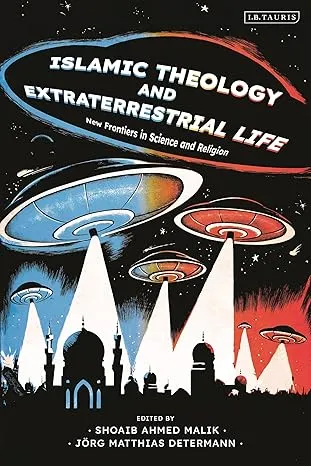
| Islamic Theology Meets ETI Shoaib Ahmed Malik and Jӧrg Matthais Determann The Society for UAP Studies (SUAPS) enjoyed an enlightening presentation this past Friday, October 3, 2025, by Jӧrg Matthais Determann. Determann is a history professor at Virginia Commonwealth University, Qatar campus. He is also an associate editor of the Review of Middle East Studies. Appearing on screen while in Qatar, Determann gifted us with a historical review of the degree to which Islamic societies have become excited over flying saucers, UFOs, space aliens, and serious UAP Studies. Might there be room in Islamic theology for extraterrestrial intelligent life (ETI)? Might there be room in Islamic theology for space aliens who are superior to us in intelligence and spirituality? Well, certainly not if you’re an anthropocentrist. Not if you believe we human beings are the apple of God’s eye. Not if you believe that we human beings have been given dominion over all creation by God, dominion even over what happens on exoplanets. Both Muslim and Christian theologians are taking a critical look at anthropocentrism and pondering how to approach new space neighbors. With his colleague, Shoaib Ahmed Malik, Determann has co-edited a book that frankly and carefully addresses these issues from a scholarly perspective, Islamic Theology and Extraterrestrial Life. This is perhaps a Kairos moment in global Islam, because Muslim ufologists are anxious to think through issues regarding ETI with theological input. “There is a need for a productive dialogue between communities such as Islamic UFOs and traditionally trained Muslim scholars to formulate a more coherent Islamic exotheology,” writes Ayuband Ilham Ibrahim, an Indonesian journalist and student at State Islamic University of Sunan Kalijaga Yogyakarta, (Ibrahim 2024, 288). Exotheology and Astrotheology Enter astrotheology. Sometimes called exotheology. Here’s my definition. “Astrotheology is that branch of theology which provides a critical analysis of the contemporary space sciences combined with an explication of classic doctrines such as creation and Christology for the purpose of constructing a comprehensive and meaningful understanding of our human situation within an astonishingly immense cosmos” (Peters 2018, 11-12). Now, let’s ask Shoaib Ahmed Malik to weigh in. Malik is a Visiting Researcher at St. Mary’s University, Twickenham, UK. He holds two PhDs, one in Chemical Engineering and the other in Theology. I’m pleased that Malik also serves on the editorial board of Theology and Science. Malik offers his definition. “Exotheology is an emerging field of study that seeks to explore the theological implications of the existence of extraterrestrial life. Sometimes also called astrotheology, it is an interdisciplinary field that involves the intersection of religion, philosophy and science. It seeks to answer fundamental questions about the nature of God, the meaning of human existence and the role of religion in a cosmological landscape” (Malik 2024, 26). Malik’s method is to appeal both to the Qur’an and to scholastic theology (kalām) when speculating on ETI. Let’s take a closer look. Shoaib Ahmed Malik’s Theological and Scientific Argument for Intellectually Superior ETI Shoab Malik threads Qur’anic and kalām needles to sew an argument for human acceptance of ETI, especially space neighbors who might be our superiors. To my reading, Malik’s argument is tailored in five stitches. Stitch one is to open the authority of the Qur’an to make room for speculation about ETI who might be more intelligent than we are. Malik cites Muzaffar Iqbal at the Center for Islamic Sciences and former editor of Islam and Science. Iqbal, in turn, cites the Qur’an 17:70: “And We have certainly preferred them over much of what We have created” (Iqbal 2018). God prefers humanity, to be sure, but not over all that is created. Only over “much.” For both Malik and Iqbal, the Qurʾān leaves open the question of what constitutes the best of creation. Malik’s appeal to Iqbal is fitting, in my judgment. One needs to open the door of the Qur’an before walking through it with theology and science. “Some Christians interpret their scripture in such a way that the Bible welcomes Aliens to Earth. For the Muslim, the Qur’an does not exactly welcome aliens to our planet, although the Qur’an does not put up any ‘no trespassing’ signs. Theologically, what is important is that extraterrestrial intelligent creatures are, like us, creatures of God” (Iqbal 2018, 226). Stitch two in Maliki’s argument is to retrieve the contention of Fakhr al-Dīn al-Rāzī’s [d.1210] that, when compared with angels, we are not required to rely on the premise that human beings are superior. Al-Rāzī’s “theological framework challenges anthropocentric assumptions about human superiority, advocating for a nuanced understanding of humanity’s place within the cosmic order. For al-Rāzī, celestial angels are clearly superior to humans due to their metaphysical and spiritual attributes, as well as scriptural backing (Malik, “Houston, al-Rāzī Has a Problem: Are Humans (Really) the Best of Creation?” 2025, 415). Stitch three in Malik’s argument is to discern what might be a gradation in the Islamic metaphysical scheme. “A foundational implication of al-Rāzī’s theological framework is the possibility of a metaphysical gradient within creation, a spectrum of beings possessing varying degrees of excellence in intellect, spirituality, and proximity to the divine” (Malik, “Houston, al-Rāzī Has a Problem: Are Humans (Really) the Best of Creation?” 2025, 432). If there is a “metaphysical gradient,” then humanity need not necessarily occupy top spot. Stitch four invokes an equivalent to the Copernican principle to demote life on Earth. This is Malik’s turn to science. After Copernicus relocated the sun, placing it at the center of our solar system, the centrality and hence the importance of Earth was decentered. Physical de-centering, accordingly, translates into denying Earth’s creatures significant meaning or importance. Note the logic: from a physical observation to a conclusion about meaning. Writing in Astronomy Today, Eric Chaisson and Steve McMillan make us feel small. “This removal of the Earth from any position of great cosmological significance is generally known, even today, as the Copernican Principle. It has become a cornerstrone of modern astrophysics” (Chaisson 2014, 43). If a scientist says such a thing, we are supposed to believe it. Right? Frankly, I find the Copernican Principle fallacious. If scientists voluntarily remove themselves from discerning the meaning of things to be objective, they dare not draw meaning out of the physical location of the Sun and Earth. They are practicing theology without a license. Be that as it may, this is an attractive though not decisive stitch in Malik’s argument. For Malik, de-centering Earth leads to demoting the rank of humanity on the cosmic gradient. Malik relies on something like the Copernican Principle to humble us so that we can accept ETI who are smarter than we are. “The recognition of Earth’s relative insignificance in the vast cosmos amplifies the possibility of intelligent beings inhabiting realms far grander in scale or significance. If humanity’s dominion is confined to a tiny speck in the universe, could beings dwelling in larger, more complex regions possess superior authority or closer proximity to the divine?” (Malik, “Houston, al-Rāzī Has a Problem: Are Humans (Really) the Best of Creation?” 2025, 433). Finally, stitch five sews together the theological and scientific opening to superiority with speculations about higher intelligence living on exoplanets. “The door opens to broader theological possibilities. This insight becomes especially relevant in modern discourse as we confront scientific provocations like the search for ETI, which challenge static notions of human uniqueness. Al-Rāzī’s framework thus supplies an interesting precedent for considering new forms of intelligence that might surpass humanity in spirituality or intellect, encouraging contemporary Muslim theologians and scholars of religion alike to reconfigure the place of humanity within a universe far more expansive and mysterious than ever before imagined” (Malik, “Houston, al-Rāzī Has a Problem: Are Humans (Really) the Best of Creation?” 2025, 435). Whew! We’ve done it. Both the Qur’an and Islamic kalām combined with the Copernican Principle have opened the door to speculation that space neighbors living on exoplanets just may be superior to us in intelligence or even spirituality. Space aliens, just like us, are beloved creatures of the one God. Conclusion I am deeply grateful to scholars such as Muzzafar Iqbal, Jӧrg Determann, and Shoaib Malik. Christian thinkers have been traveling this path for a period already. And by no means have we reached what we might call a destination. So, I’m grateful because now our Muslim colleagues are marching forward on a parallel route that could benefit the worldwide Islamic community. And any clarity of thinking that might arise in this endeavor will help us all. Author: Ted Peters directs traffic at the intersection of science, religion, and ethics. Peters is an emeritus professor at the Graduate Theological Union, where he co-edits the journal, Theology and Science, with Robert John Russell on behalf of the Center for Theology and the Natural Sciences, in Berkeley, California, USA. He authored Playing God? Genetic Determinism and Human Freedom? (Routledge, 2nd ed., 2002) as well as Science, Theology, and Ethics (Ashgate 2003). Along with Martinez Hewlett, Joshua Moritz, and Robert John Russell, he co-edited, Astrotheology: Science and Theology Meet Extraterrestrial Intelligence (2018). Along with Octavio Chon Torres, Joseph Seckbach, and Russell Gordon, he co-edited, Astrobiology: Science, Ethics, and Public Policy (Scrivener 2021). Along with Arvin Gouw and Brian Patrick Green, he co-edited Religious Transhumanism and Its Critics (Lexington 2022). He is also author of UFOs: God’s Chariots? Spirituality, Ancient Aliens, and Religious Yearnings in the Age of Extraterrestrials (Career Press New Page Books, 2014). Look for his newest book, The Voice of Public Theology, a collection of previous articles. See his website: TedsTimelyTake.com. |
Islamic Theology Meets ETI
09
Oct