2025 UNESCO PT in Forum
Reprint of Substack SR 4003 Open Science, UNESCO, and Public Theology
Open Science, UNESCO, and Public Theology
Why should the public theologian ally with the scientist?
By
Ted Peters
Does science rely upon a morality of knowledge? It certainly does.
Here is the cardinal moral principle of natural science: we must expunge our prejudices and biases in order to attune our mind solely to what nature reveals. A fact should be honored, respected, perhaps even revered. A hypothesis should be subjected to rigorous testing against known facts. New knowledge should be transparent, treasured, and shared with everyone.
The good news is that the United Nations commits itself to this morality of knowledge.

I believe public theologians in various religious traditions should welcome this morality of knowledge while making a special commitment to keeping scientific research open. By open, I mean new knowledge should be shared widely on behalf of the global common good.
Yes, of course, there is much more to know than just what science uncovers. We dare not expect our scientists to explain ultimate reality. Yet, amidst the present cultural turmoil, the scientific community more than any other offers sanity, stability, and reasoned judgments.
The Swarm of Pseudo-Science and Fake Facts
Like a ripening cornfield invaded by a plague of swarming locusts, today’s defenseless minds are overwhelmed by the rabblement of truths, half-truths, misinformation, disinformation, cancel culture, advertising, and deliberate lies. The web mind is deluged by a relentless flood of worldviews, claims, counterclaims, and fabricated lies disguised as facts (Peters, Allies in the Struggle Against the Post-Truth Swarm 2019). Some universities, overzealously pursuing racial and gender justice, impose liberal ideology upon science education to such a degree that prominent researchers lose their faculty positions to cancel culture (Krauss, 2025). In the United States, a war against science has been launched by the White House. The 47th US president has cut funding to the National Institutes of Health and appointed cabinet leadership that jeopardizes the nation’s health by appealing to anti-vax ideology.
Scientists and non-scientists are engulfed in intellectual turmoil, making this a kairos moment for the public theologian to stand up courageously for factual truth, evidence-based reasoning, self-criticism, and fairness in judgment (Peters, Do you trust science? 2024). The good news is that the United Nations has taken a stand on behalf of open science.
UNESCO Recommendation on Open Science
The United Nations Educational, Scientific and Cultural Organization (UNESCO) has promulgated an astute “Recommendation on Open Science” that provides an internationally agreed upon concept of science along with a set of shared values and guiding principles for open science. UNESCO also identifies a set of actions conducive to a fair and equitable operationalization of open science for all at the individual, institutional, national, regional, and international levels. Here are some notable provisions.
· Scientific agencies the world over should make multilingual scientific knowledge openly available, accessible and reusable for everyone.
· Societies should increase scientific collaborations and sharing of information for the benefits of science and society.
· We all should promote science that is more accessible, inclusive and transparent; Open science furthers the right of everyone to share in scientific advancement and its benefits as stated in Article 27.1 of the Universal Declaration of Human Rights.
In brief, science is not just for scientists. Science is valuable for the global common good (Peters, Natural Science in Public Christian Philosophy and Public Systematic Theology 2021).
Promoting healthy science is one responsibility of the public theologian
Paul S. Chung reminds us that…
“Public theology necessarily engages in the science-religion dialogue about ecological awareness and the scientific understanding of the Earth and creaturely life” (Chung 2016, 199).
Truth is at stake. A society that has lost its commitment to truth will dissolve into mayhem until a strong dictator establishes a police state ordered by fascist authority. Our allies in white lab coats are especially equipped to defend truth for democracy’s sake.
In today’s cultural combat, we public theologians should thank the scientist who marches most courageously in defense of intellectual integrity. Science as an army raises the flag of evidence-based reasoning and asks that the norms of evidence-based reasoning apply to government policy as well as wider public discourse (Peters, Public Theology, Discourse Clarification, and Worldview Construction 2021).
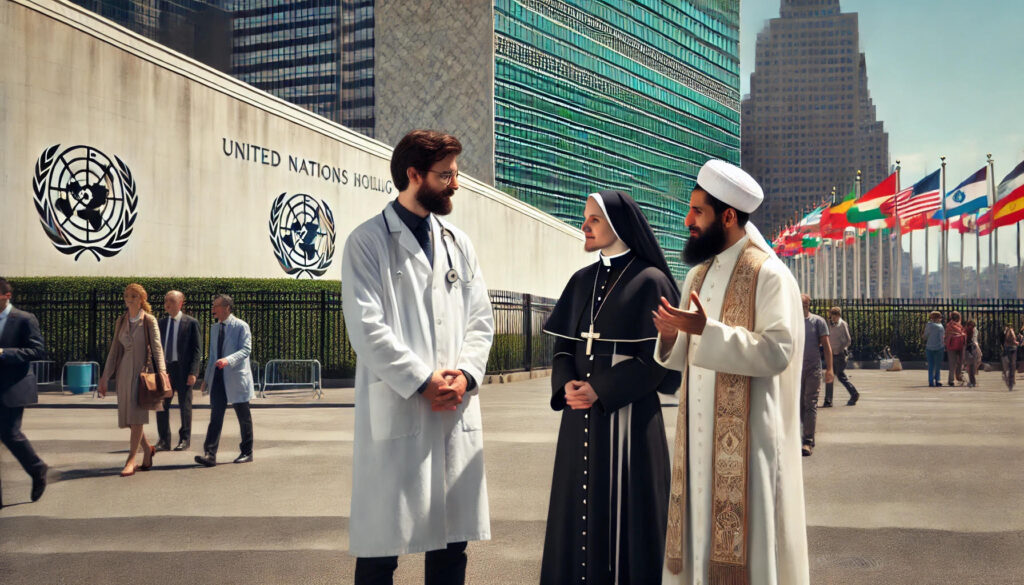
The enemies to truth that have polluted and overwhelmed electronic discourse include, it is sad to say, the U.S. government. When without shame US government leaders show disregard for scientific data — especially scientific data announcing a crisis in climate change — then the resulting policy leads the entire country if not the world like the Pied Piper of Hamlin over a cliff. In Scientific American we hear the siren alarming us.
“Scientists around the country are nervous as hell. There seems to be a scientific happening in Washington, DC, and our government’s relationship with facts, scientific reality and objective truth has never been more strained“ (Foley 5/2017).
Conclusion
Science as a set of academic disciplines touts a morality of knowledge that could benefit us all. The commitment of science at its best to empirical truth — what we commonly know as facts — contributes to the integrity of all modern institutions. While under siege from the current swarm of half-truths and deceit, public theologians should ally themselves with scientists in taking a stand in defense of reason, transparency, and the common good.
In short, public theologians within the world’s religions should stand up in support of open science and thank our friends wearing white lab coats as well as UNESCO’s farsighted leadership (Peters, The Voice of Public Theology 2023).
Substack SR 4003 Open Science, UNESCO, and Public Theology
Patheos SR 1015 Should Christians Dump Darwin?
Patheos SR 1016 Evolution and Involution in Vedic Science
Patheos SR 1017 Buddhism and Science on Our Mind
Patheos SR 1018 The Danger of Free Will Denial
Patheos SR 4000 What is Truth in Science and Theology? Part One
Patheos SR 4001 What is Truth in Science and Theology? Part Two
Patheos SR 4002 What is Truth?
▓
Meet Ted Peters. Ted Peters directs traffic at the intersection of science, religion, and ethics. Ted is an emeritus professor at the Graduate Theological Union, where he co-edits the journal, Theology and Science, with Robert John Russell on behalf of the Center for Theology and the Natural Sciences, in Berkeley, California, USA. He authored Playing God? Genetic Determinism and Human Freedom? (Routledge, 2nd ed., 2002) as well as Science, Theology, and Ethics (Ashgate 2003). Along with Martinez Hewlett, Joshua Moritz, and Robert John Russell, he co-edited, Astrotheology: Science and Theology Meet Extraterrestrial Intelligence (2018). Along with Octavio Chon Torres, Joseph Seckbach, and Russell Gordon, he co-edited, Astrobiology: Science, Ethics, and Public Policy (Scrivener 2021). Along with Arvin Gouw and Brian Patrick Green, he co-edited Religious Transhumanism and Its Critics (Lexington 2022). This year Ted edited The Promise and Peril of AI and IA: New Technology Meets Religion, Theology, and Ethics (ATF 2025) and co-edited with Arvin Gouw The CRISPR Revolution in Science, Religion, and Ethics (Bloomsbury, 2025).
His theme volume is The Voice of Public Theology, a collection of previous articles. See his website: TedsTimelyTake.com.
▓
References
Chung, Paul. 2016. Postcolonial Public Theology: Faith, Scientific Rationality, and Prophetic Dialogue. Eugene OR: Cascade Books.
Foley, Jonathan. 5/2017. “The War on Facts Undermines Democracy.” Scientific American 316:5 10.
Krauss, Lawrence M. Ed. 2025. The War on Science. New York: Post Hill.
Peters, Ted. 2019. “Allies in the Struggle Against the Post-Truth Swarm.” Theology and Science 17:4 427-430.
Peters, Ted. 2024. “Do you trust science?” Theology and Science 22:1 1-8. DOI: 10.1111/dial.12845.
Peters, Ted. 2021. “Natural Science in Public Christian Philosophy and Public Systematic Theology.” Forum Philosophicum 26:1 13-34. DOI: 10.35765/forphil.2021.2601.03.
Peters, Ted. 2021. “Public Theology, Discourse Clarification, and Worldview Construction.” Theology and Science 19:1 1-4; DOI.org/10.1080/14746700.2020.1869672 .
Peters, Ted. 2018. “Public Theology: Its Pastoral, Apologetic, Scientific, Political, and Prophetic Tasks.” International Journal of Public Theology 12 (2): 153-177.
Peters, Ted. 2023. The Voice of Public Theology. Adelaide: ATF.